Introduction
Picture a potential diner on a Saturday night, phone in hand, searching "Italian restaurants near me." Two options appear side by side. The first has 340 Google reviews, the most recent posted three days ago. The second has great food — you know it, your regulars know it — but 47 reviews, the newest from five months ago. Which one gets the reservation?
According to TouchBistro's 2024 Dining Trends Report, 67% of diners always or often check online reviews before visiting a restaurant for the first time. The food doesn't matter if they never walk in.
Most restaurant owners know reviews matter. The real gap is execution. Asking manually is awkward, easy to forget during a dinner rush, and inconsistent at best. Automatic review generation removes the ask entirely — the system handles it every time, at exactly the right moment.
This guide walks through how automation works in practice, which platforms deserve your attention, and the specific steps that turn more review requests into published reviews that bring new diners through the door.
Key Takeaways
- 67% of diners check reviews before a first visit — your rating is your first impression
- Google drives 46% of restaurant rating checks; it should always be your primary platform
- Automatic review generation sends follow-up requests after each visit — no staff effort required
- Smart routing intercepts unhappy customers privately before a negative review goes live
- Without proactive reputation management, 30% of customers lost to bad experiences never come back — Repute Sync data
Why Online Reviews Make or Break a Restaurant
The Revenue Connection Is Real
The financial stakes of your star rating aren't abstract. An HBS study of Seattle restaurants found that a one-star increase on Yelp correlated with a 5–9% revenue increase for independent restaurants. A separate study found that restaurants rounding up to the next half-star sold out 19 percentage points more frequently — a 49% relative increase in table turnover.
For a restaurant doing $1.2M annually, a 5% revenue swing is $60,000. That's not a rounding error.
Reviews Are Now the Primary Discovery Tool
Word of mouth still matters, but it's been digitized. PYMNTS' 2023 consumer research found 62% of consumers discover restaurants on Google before ever setting foot near the location.
First-time diners still ask friends — but only after checking ratings first. Your online presence is doing the work your front-of-house staff used to do.
Review Recency Signals Whether You're Still Open
A restaurant with 200 reviews but nothing posted in several months creates doubt. Is this place still operating? Did something change? Diners make these assumptions fast, and they move on.
Fresh reviews signal an active, well-run business. Stale profiles — even with a solid overall rating — signal neglect. Consistency matters as much as volume.
The Cost of Ignoring Negative Reviews
Repute Sync's platform data shows 30% of customers lost to negative experiences don't return without proactive reputation management. That's a permanent loss of repeat business from customers you've already spent money acquiring.
When negative reviews go unanswered and your review pipeline stalls, those are the only voices shaping first impressions — and new diners are deciding based on them before you ever get a chance to serve them.
Local SEO: Reviews Affect Who Finds You
Google's own documentation confirms that review volume and positive ratings directly influence local rankings. Reviews containing location and cuisine keywords help your restaurant appear in "near me" searches — and that's where walk-in traffic starts.
What Is Automatic Review Generation?
Automatic review generation is software that automatically sends review requests to diners after their visit — without anyone on your team remembering to ask.
What It Is (and Isn't)
What it IS:
- Automated, timed outreach to real customers who dined at your restaurant
- Triggered by an event (a completed meal, a reservation, a POS transaction)
- A direct link that takes the customer straight to the review platform
What it is NOT:
- Fabricating reviews or posting fake feedback
- Paying or discounting in exchange for positive reviews
- A way to game the system — platform policies still apply
Google permits businesses to request genuine reviews and share direct review links. Yelp, however, explicitly discourages direct solicitation — their guidelines state businesses should not ask anyone to review them. Any automated workflow needs to respect this distinction — more on platform-specific rules in the next section.
Why Manual Collection Fails
Manual review collection sounds manageable until it isn't:
- Staff forget to mention it during a busy service
- Verbal asks feel awkward and inconsistent
- Table cards and receipts get ignored or thrown away
- Social media posts reach existing followers, not first-time diners
Most restaurants end up with a trickle of reviews when they need a consistent pipeline. Automation fixes that gap without adding to anyone's workload.
How the Timing Works
The most effective trigger points for automated review requests include:
- Completed reservation — flagged as seated and finished in the reservation system
- POS transaction — a closed check signals the meal is done
- Loyalty app check-in — the customer's visit is logged automatically
- WiFi portal sign-in — contact info captured at the time of connection
Each of these creates a natural, event-driven moment to reach out — no guessing, no manual tracking.
Generation vs. Management: Know the Difference
Automatic review generation fills the top of the funnel — it gets new reviews created consistently. Review management handles what comes in: monitoring, responding, and tracking sentiment over time. Both matter, but generation is where most restaurants fall behind first. Getting that flow started is the prerequisite for everything else.
How Automatic Review Generation Works for Restaurants
The Basic Workflow
The process follows a simple sequence:
- Customer dines at your restaurant
- Contact information is captured via reservation platform, POS, loyalty app, or WiFi sign-in
- Automated message triggers at a set interval post-visit (typically within a few hours)
- Customer receives a direct link to your chosen review platform — one tap, no navigation required
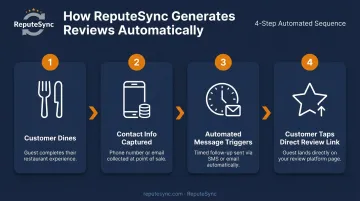
The less friction in that last step, the higher your conversion rate from request to published review.
Which Channels Work Best
The three main delivery channels for review requests each have distinct strengths:
| Channel | Best For | Notes |
|---|---|---|
| SMS | Immediate reach, high open rates | Most effective for post-visit outreach |
| Loyalty program members with email on file | Works well for restaurants with CRM data | |
| QR codes | In-the-moment requests at the table or receipt | Useful when contact data isn't captured digitally |
SMS tends to outperform email for restaurant review requests because people check texts quickly and the friction is lower, making it the path of least resistance for a busy diner.
Smart Routing: Protecting Your Public Rating
Smart routing filters feedback before it reaches a public platform. Here's how it works:
- The system sends an initial question: "How was your experience today?"
- Positive responses get directed to Google, Yelp, or your chosen public platform
- Negative responses get routed to a private feedback form
This captures actionable criticism internally — giving you a chance to fix the problem — while guiding satisfied customers toward your public profile. Unhappy customers are still heard; the difference is you get a chance to respond before the complaint goes public.
Smart routing handles the quality side of review generation. The next layer — reminders and multi-platform coordination — handles volume and coverage. Repute Sync's platform combines both, with sentiment tracking and feedback tools built into the same dashboard.
Follow-Up Reminders and Multi-Platform Coordination
Two features that meaningfully improve results:
- Automated reminders — if a customer receives a request but doesn't act within a set interval, the system sends a polite follow-up. This significantly lifts overall conversion from request to published review.
- Multi-platform management — rather than logging into Google, Yelp, TripAdvisor, and OpenTable separately, platforms like Repute Sync consolidate this into a single dashboard. You can direct customers to whichever platform most needs attention without manual tracking across multiple accounts.
Key Platforms Restaurants Should Target
Not every review platform deserves equal energy. Here's where to focus and why.
Google: Non-Negotiable Priority
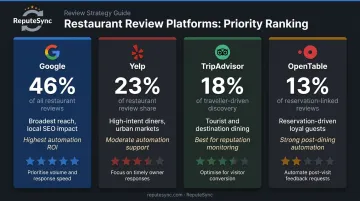
Toast's 2024 restaurant survey found 46% of diners check Google first for restaurant ratings. A separate PYMNTS study found 62% use Google specifically to discover restaurants.
Google reviews feed directly into Google Maps rankings. More reviews, combined with relevant keywords, help your restaurant appear higher in local "near me" searches — the dominant tool for walk-in and first-visit discovery.
Yelp: Meaningful but Handle Carefully
In the same Toast survey, 23% of diners check Yelp first — making it the clear second platform for restaurant discovery. Yelp has a strong, food-focused user base and carries weight particularly in urban markets.
One caveat worth knowing: Yelp explicitly discourages businesses from asking customers for reviews. Any automated workflow targeting Yelp specifically would conflict with their guidelines. Focus automation on Google, and let Yelp reviews accumulate organically.
TripAdvisor and OpenTable: Secondary but Valuable
- 70% of travelers in a Tripadvisor/Ipsos study rated reviews very or extremely important when booking a restaurant. For tourist-area or destination dining concepts, TripAdvisor carries disproportionate weight.
- OpenTable limits reviews to diners who booked and honored a reservation — making them among the most credible available. OpenTable's 2025 Top 100 list drew from over 10 million verified diner reviews. If you're already using OpenTable for reservations, review collection happens automatically post-visit.
Best Practices to Maximize Review Quality and Quantity
Nail the Timing
The optimal window for sending a review request is 1–4 hours after the dining experience ends. OpenTable, for example, sends push notifications approximately three hours after a reservation is marked seated.
Why this window works:
- The meal is vivid in the customer's memory
- They've had time to settle and reflect
- They're not mid-meal or mid-commute
Sending the next morning or days later dramatically reduces response rates. The experience feels distant, and the urgency to share it fades.
Keep the Ask Frictionless
Every additional step between the customer and the "Submit" button reduces your completion rate. Your review request should:
- Be brief and warm — two to three sentences maximum
- Contain a direct link to the review platform (no searching required)
- Work on mobile without requiring a login or app download
Google officially supports and encourages businesses to share direct review links and QR codes for exactly this reason. The shorter the path from request to submission, the higher your response rate.
Train Staff to Prime the Experience
Automation handles the request, but your team controls the experience that determines whether the customer wants to leave a five-star review.
Staff behaviors that improve review rates:
- A manager stopping by the table mid-meal to check in
- A server who remembers a dietary preference or a regular's usual order
- A memorable moment — an unexpected dessert, a sincere birthday acknowledgment
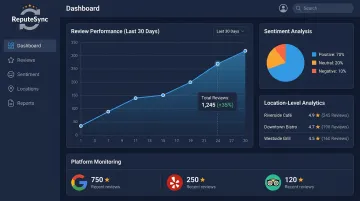
Repute Sync's platform tracks review performance over time, giving owners visibility into which locations or time periods generate more reviews. That data can reveal which service behaviors correlate with better review volume, so managers can reinforce what's working during team briefings.
Frequently Asked Questions
What is automatic review generation for restaurants?
It's software that sends review requests to diners automatically after their visit — via SMS, email, or QR code — without requiring any manual follow-up from your team. The system triggers based on a completed visit or transaction and directs customers to your chosen review platform with a single tap.
Is it against Google's or Yelp's policy to automatically request reviews?
Google permits businesses to request genuine reviews and share direct review links — what's prohibited is incentivizing reviews with discounts or freebies. Yelp takes the opposite stance and discourages direct review requests altogether. Automated workflows should target Google as the primary channel and approach Yelp differently to stay within their guidelines.
Which review platform should restaurants focus on first?
Google. It drives 46% of restaurant rating checks and directly influences local search rankings on Google Maps. After Google, Yelp is the second-largest discovery platform for restaurants. TripAdvisor and OpenTable are worth attention for tourist-heavy or reservation-driven establishments.
How do restaurants collect customer contact information for automated review requests?
The most common collection methods are reservation platforms (OpenTable, Resy), POS systems that store customer data, loyalty programs, and WiFi sign-in portals.
How soon after a meal should a review request be sent?
The 1–4 hour post-visit window is the sweet spot. The experience is still fresh enough to feel vivid, but the customer has had time to settle and reflect. Waiting until the next morning or later significantly reduces the likelihood of a response.
Can automatic review generation help a restaurant recover from negative reviews?
Yes. Consistently generating new positive reviews dilutes the impact of occasional negative ones and lifts your overall rating over time. Automation can also route unhappy customers to a private feedback channel before they post publicly, giving you a chance to resolve the issue directly.