The catch? How you ask matters as much as whether you ask. Timing, channel, wording, and ease of process each affect response rates dramatically — and getting any one of them wrong means losing social proof that would otherwise bring new diners through the door.
This guide covers the exact steps to ask for reviews effectively, the best channels to use for restaurants, and the mistakes that quietly kill response rates.
Key Takeaways
- 83% of consumers leave a review when asked — but most restaurants never ask systematically
- Ask within 24–48 hours of a positive visit, when memory and emotion are both fresh
- Personalized requests consistently outperform generic copy-paste messages — specific details about the visit drive higher response rates
- One-click links and QR codes are the single biggest lever for improving review volume
- Respond to every review — it shows Google and future diners that your restaurant is responsive and pays attention
How to Ask Customers for Reviews: A Step-by-Step Approach
Step 1: Identify the Right Customers to Ask
Not every diner should receive a review request. Soliciting indiscriminately risks inviting lukewarm feedback or, worse, giving a dissatisfied customer a prompt to go public.
Focus your requests on:
- Repeat diners who have visited more than once
- Loyalty program members with a positive purchase history
- Customers who complimented staff or engaged warmly during the meal
- Guests who made reservations and stayed through dessert
These customers produce more detailed, narrative reviews — the kind that actually influence prospective diners browsing Google. A glowing paragraph from a regular is worth ten generic star submissions.
Step 2: Time Your Request Strategically
For dine-in restaurants, the emotional high point occurs right after the meal ends. That's your best window for an in-person or table-side request. For digital follow-ups, research on food and drink brands shows 24% of consumers prefer a same-day request and 48% prefer one within 2–3 days — so send promptly rather than waiting until the following week.
When not to ask:
- While the customer is waiting for their check during a rush
- Immediately following a service complaint or visible frustration
- More than 72 hours after the visit, when specific memories have faded
Step 3: Craft a Clear, Personalized Request
Generic copy-paste messages signal low effort. A request that addresses the customer by name — and ideally references something specific about their visit — converts at a higher rate.
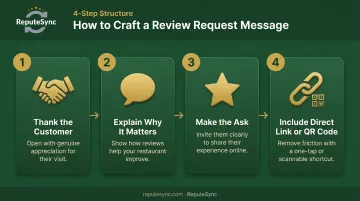
Optimal message structure:
- Thank the customer for dining
- Briefly explain why the review matters to your restaurant
- Make the specific ask
- Include a direct link or QR code as the next step
Keep the whole message under 3–4 sentences for SMS, or under 100 words for email. Brevity respects their time and increases completion rates.
Step 4: Make It Effortless to Leave the Review
Every extra step a diner must take reduces the chance they'll follow through. Fewer clicks directly equals more reviews.
- Include a direct one-click link that opens the review submission screen immediately
- Use QR codes on receipts, table cards, or check presenters
- Name the specific platform — Google, Yelp, TripAdvisor — rather than asking customers to "find us online"
- Focus on one primary platform first to build volume faster before spreading requests across multiple sites
"Find us online" is a task, not a request — and most diners won't bother completing it.
Step 5: Follow Up Once, Then Respond to Everything
A single polite follow-up sent 48–72 hours after the initial request is reasonable. Beyond that, you risk damaging the relationship. One follow-up, maximum.
Equally important: respond to every review you receive. Google explicitly states that review count and score affect local rankings, and recommends responding to show the business values customer feedback.
Beyond SEO, 93% of consumers expect a business to respond to reviews. An unanswered review signals to prospective diners that management isn't paying attention.
When to Ask Customers for a Review
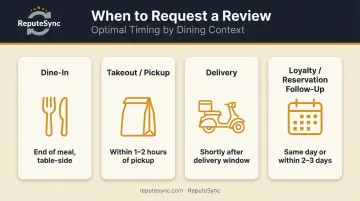
Timing isn't interchangeable across dining contexts.
| Context | Best Timing |
|---|---|
| Dine-in | End of meal, table-side — highest conversion |
| Takeout/pickup | Within 1–2 hours after estimated pickup time |
| Delivery | Shortly after estimated delivery window closes |
| Loyalty/reservation follow-up | Same day or within 2–3 days via SMS or email |
Avoid asking during any visible service failure. A diner who just flagged a problem with their order is not in the right frame of mind — and prompting them at that moment risks getting a negative review you might have otherwise avoided entirely.
Once you've handled timing around service issues, it's also worth thinking about time of day. Older ReviewTrackers data (2021) identified 2–3 PM and 6–7 PM as peak windows for consumers posting reviews — a pattern that makes sense: people review after meals, not during work hours. If you're scheduling automated follow-up messages, test sends around those windows to maximize open and response rates.
Best Channels for Collecting Restaurant Reviews
In-Person and Table-Side Requests
The table-side request captures the diner at their emotional peak — full, satisfied, and still in your space — and no digital channel comes close to that moment.
Practical tools:
- Server scripts — keep it natural: "If you enjoyed your evening, we'd love it if you left us a Google review — here's a card with the link"
- Printed table tent cards with a QR code
- QR codes on receipts or check presenters
For fast-casual and high-turnover concepts, printed QR cards eliminate any awkwardness from verbal pitching. The diner scans on their own terms.
SMS and Text Message
SMS is the most effective digital channel for restaurant review requests. Birdeye's 2024 platform data shows SMS review requests achieve a 38% response rate, compared to 27% for email — a meaningful gap in high-volume environments.
SMS template for restaurants:
Hi [Name], thanks for dining with us tonight! We'd love to hear about your experience — your review helps other diners find us. [Direct Google Review Link]
Guidelines:
- Keep it under 160 characters when possible
- Send within 1–2 hours of the visit
- Use the customer's first name
- Include a direct, platform-specific link — no navigation required
Email works best when you already have guest contact information through reservation platforms, loyalty programs, or online ordering systems.
Subject line approach: "How was your dinner at [Restaurant Name]?" — direct, specific, low-pressure.
The body should contain one CTA button linking directly to the review page. Don't include three asks or a newsletter signup. One thing.
MailerLite's 2025 benchmark data shows restaurants and cafes average a 44.32% email open rate — strong enough to justify a well-crafted review request campaign to your existing guest list.
Automated Review Collection Tools
Each of the channels above works. The harder problem is executing all of them consistently across every shift, every guest, every location. For high-volume or multi-location restaurants, manual follow-up doesn't scale.
Automation solves that by triggering personalized review requests after each visit and managing responses across platforms from a single dashboard — no logging into four different sites.
Repute Sync is built specifically for restaurants. It automates review collection, monitors incoming reviews in real time, and gives owners the tools to track performance and respond professionally across platforms. You can learn more or book a demo at reputesync.com.
Key Factors That Affect Your Review Response Rate
The act of asking is necessary but not sufficient. Four variables control how many diners actually follow through.
Personalization Level
A request that uses the customer's name and references something specific about their visit — the occasion, the dish, the table they booked — consistently outperforms a generic blast. Diners who feel like a number rarely invest time in a thoughtful response. Generic messages read as automated — because they are.
Personalized requests also tend to produce longer, more narrative reviews rather than star-only submissions. A five-star review with three sentences of specific praise has more influence on prospective diners than five stars and no comment.
Channel and Format of the Request
Channel selection determines who sees the request and when. Each channel serves a different moment:
- SMS — reaches customers within minutes; best for post-visit follow-ups
- Email — suits loyalty database contacts and allows richer formatting
- In-person QR codes — captures the emotionally peaked diner on the spot
The format of the link matters just as much as the channel. A direct link that opens the review submission screen outperforms any request requiring the customer to navigate, search, or log in separately.
Request Frequency and Cadence
Asking too frequently — every visit for a regular, for example — feels like pressure and can cause loyal customers to disengage. Waiting too long past 72 hours causes memory to fade, producing vaguer, less specific reviews.
The cadence is simple: one initial request, one follow-up at 48–72 hours if there's no response, then stop.
Platform Selection and Focus
Spreading review requests across Google, Yelp, TripAdvisor, and Facebook simultaneously dilutes your volume and slows the momentum you need to rank on any single platform.
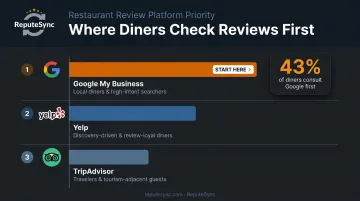
A 2024 HungerRush survey of 1,000 US adults found 43% of diners consult Google reviews before visiting a restaurant — more than any other channel. Start there. Build volume on Google first, then branch to secondary platforms once your primary profile is strong.
Common Mistakes When Asking for Reviews
Asking at the wrong moment — During a service complaint, mid-rush checkout, or days after the visit, you'll either get silence or a review that hurts your rating. The best window is right after a positive interaction, while the experience is still fresh.
Using generic, impersonal requests — Copy-paste messages with no personalization read as automated. Diners who feel like a number won't write a thoughtful review.
Creating too much friction — Requiring customers to log in, search manually, or navigate multiple pages is the top cause of drop-off. Every extra click costs you completions.
Offering incentives or buying reviews — Google and Yelp both explicitly prohibit incentivized reviews. Exchanging discounts or freebies for reviews violates platform terms and FTC guidelines, risking removal or listing penalties.
Ignoring reviews you already have — Chasing new reviews while leaving existing ones unanswered tells both Google and prospective diners that your responsiveness is selective — respond to everything.
Frequently Asked Questions
How do you politely ask for a review?
Thank the customer sincerely first, then frame the request as a favor that helps other diners make informed choices. A brief, natural message with a direct link works far better than a formal or scripted demand. Keep it conversational and specific to their visit.
How do I encourage customers to give reviews?
Timing and friction are the two biggest factors. Ask within an hour of a positive experience, use a one-click link or QR code to remove any extra steps, and personalize the request with their name and a detail from their visit. The easier you make it, the more responses you'll get.
How do I ask my customers for feedback?
For public reviews, a post-visit SMS or email with a direct platform link works best — or a table-side QR code for in-the-moment requests. Keep the ask short and include only one clear call to action so customers know exactly what to do.
What review platforms should restaurant owners focus on first?
Start with Google. The majority of diners check Google before visiting a restaurant, and building review volume there produces the strongest local search benefit. Yelp and TripAdvisor matter as secondary platforms depending on your market and restaurant type — but concentrate volume on one platform before spreading efforts.
Should you respond to every customer review?
Yes. Responding to both positive and negative reviews matters for Google's local ranking signals, demonstrates that management is engaged, and encourages future diners to leave their own reviews knowing they'll be acknowledged.
Is it okay to offer a discount in exchange for a review?
No. Google, Yelp, and the FTC all prohibit or regulate incentivized reviews. Platforms can remove incentivized reviews and penalize your listing. A well-timed, personalized request with a direct link will consistently outperform any incentive — without the compliance risk.