Introduction
Most diners have already chosen where to eat before they ever leave home. They're on the couch, scrolling Google reviews, comparing star ratings, and reading how an owner responded to the last complaint about cold pasta.
You can serve exceptional food and run a flawless front-of-house experience — but if your online reputation tells a different story, potential guests will walk straight to a competitor.
According to ReviewTrackers, 55.5% of consumers consider online reviews influential when choosing a restaurant — and that figure only captures those who openly admit it. The real number shaping decisions runs higher.
This post breaks down what brand and reputation management actually means for restaurant owners, why it has a direct impact on revenue, and what concrete strategies you can use to stop leaving your reputation to chance.
Key Takeaways
- Online reviews influence more than half of diners' restaurant choices — your reputation is a sales channel
- A one-star Yelp rating increase correlates with a 5–9% revenue lift for independent restaurants
- Every review deserves a response — future diners are reading how you handle criticism
- Reputation management is proactive, not just damage control — monitoring and responding consistently is what moves the needle
- Tools like Repute Sync make this manageable without consuming your entire week
What Is Brand and Reputation Management for Restaurants?
Reputation management, stripped of jargon, is the ongoing practice of monitoring, shaping, and protecting how your restaurant is perceived — across review platforms, social media, local search, and your community.
For restaurants, this is more immediate and more personal than corporate brand management. Your reputation lives on Google, Yelp, TripAdvisor, OpenTable, and Facebook, updated in real time by diners who had a great night out — or didn't.
Brand Identity vs. Online Reputation
These two concepts are related but distinct:
- Brand identity is what you stand for — your cuisine, atmosphere, values, and the story behind the restaurant
- Online reputation is what customers say about you publicly — your star rating, review sentiment, and how you respond
Both matter — but they work differently. A strong brand identity gives potential diners something to connect with before they ever read a review. A well-managed online reputation takes that interest and turns it into a reservation.
Reputation management is not crisis response. Waiting for a bad review to act is like cleaning the kitchen only before a health inspection — reactive, and already too late. Proactive reputation management looks different:
- Encouraging satisfied diners to leave reviews before a dissatisfied one dominates your feed
- Responding to feedback promptly, whether the review is glowing or critical
- Using patterns in customer sentiment to identify and fix recurring problems
- Treating your online presence as a living asset, not a set-and-forget profile
Why Your Restaurant's Online Reputation Directly Affects Revenue
The Review-Driven Decision Cycle
Most diners search before they choose. A low star rating or an unanswered negative review doesn't just reflect poorly on your restaurant — it actively redirects customers to whoever is ranked above you.
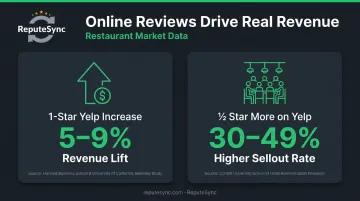
The revenue data behind this is compelling. Research by economist Michael Luca using Washington State Department of Revenue records found that a one-star increase on Yelp drove a 5–9% revenue increase for independent restaurants. Chain restaurants saw no statistically significant effect, which means the stakes are highest for the independent operators who typically have the fewest resources to manage this.
Even fractional improvements have operational consequences. A separate study found that an extra half-star on Yelp increased the probability of a restaurant selling out at prime dining times by 30–49% — with no change in price or actual service quality.
The Local SEO Connection
Your reputation doesn't just affect how diners perceive you — it affects whether they find you at all.
Google's local ranking algorithm considers relevance, distance, and prominence. More reviews and positive ratings can help your local ranking, meaning restaurants that actively generate and respond to reviews appear higher in "restaurants near me" searches. Reputation management and local discoverability are inseparable.
A well-managed reputation does more than protect you from bad press. It builds trust with first-time visitors, drives repeat business, and gives diners a reason to recommend you unprompted. Over time, those effects stack — your rating stops being something you defend and starts being something you compete with.
The Five Pillars of Restaurant Reputation Management
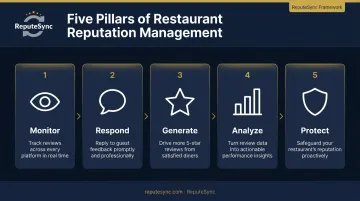
Pillar 1 — Monitor
You can't manage what you don't see. Set up monitoring across every platform where diners leave feedback: Google, Yelp, TripAdvisor, Facebook, and OpenTable. Google Alerts for your restaurant name catches mentions that fall outside the major platforms.
Unmonitored platforms are where reputational damage builds undetected.
Pillar 2 — Respond
Every review deserves a response — positive or negative. According to a BrightLocal local business survey, 88% of consumers would use a business that responds to every review, compared to just 47% for businesses that never respond.
Speed matters as much as frequency. The ReviewTrackers restaurant industry benchmark puts the average response time at 10 days — top-performing brands respond in 1.6 days. That gap is where reputations diverge.
Pillar 3 — Generate
Review recency matters to both diners and search algorithms. A stream of fresh reviews outperforms a larger but stagnant review count.
Ethical ways to encourage reviews:
- Post-meal follow-up texts (BrightLocal found 48% of diners prefer a review request within 2–3 days)
- Table cards with QR codes linking directly to your Google review page
- Receipts with a simple review prompt
One important platform note: Google permits neutral review requests; Yelp explicitly does not. Never offer incentives for reviews on any platform — it violates both platforms' policies and risks removal.
Pillar 4 — Analyze
Reviews are operational data, not just social proof. Patterns in negative feedback — slow service on Saturday nights, inconsistent quality on a specific dish — reveal real problems before they compound. Your review feed is a real-time customer satisfaction signal most operators underuse.
Pillar 5 — Protect
Crisis preparedness is a pillar, not an afterthought. A basic plan includes:
- Designate a response owner — one person is accountable for monitoring and responding
- Prepare template language for health/safety complaints, food quality issues, and social media escalations
- Know when to take it offline — some conversations should move to a phone call, not a public comment thread
How to Respond to Reviews: Turning Feedback Into Loyalty
Your review response isn't really written for the person who left it. Every future diner reading that exchange is your actual audience — and a calm, professional reply to a scathing review can convert skeptical readers into first-time guests.
ReviewTrackers reports that 45% of consumers are more likely to visit a business that responds to negative reviews — a cross-industry finding, but directionally relevant for restaurants.
Responding to Negative Reviews
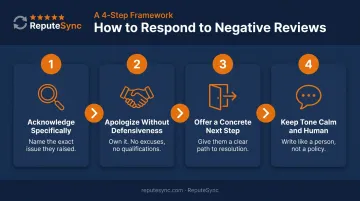
A strong negative review response has four components:
- Acknowledge specifically — reference what they experienced, not a generic "sorry you felt that way"
- Apologize without being defensive — own it, even if you dispute the details internally
- Offer a concrete next step — invite them back, provide a contact, or describe what's changed
- Keep the tone calm and human — never argue publicly
Responding to Positive Reviews
Go beyond "Thanks!" Name the dish they loved, reference the occasion they mentioned, or note the server who helped them. Then invite them back with something specific — a new menu item, an upcoming event, a dish you think they'd enjoy. Readers notice this level of engagement, and it tells them more about your restaurant than any ad would.
Timing
Response time matters for both review types. Aim to reply within 24–48 hours — negative reviews first, since they shape reader opinion every day they sit unanswered. Build a simple daily habit: check your review platforms each morning alongside your opening tasks, so nothing slips through during a busy week.
Handling Fake or Malicious Reviews
Not every negative review is legitimate. If you suspect a fake review:
- On Google: Flag it through your Business Profile or Google's Reviews Management Tool. Google removes reviews that violate policy and permits a one-time appeal.
- On Yelp: Open the review's three-dot menu and select "Report Review." Yelp evaluates against its Content Guidelines and notifies you of the decision.
When responding publicly to a suspected fake review, stay professional. State factually that you can't locate a record of the experience and invite the person to contact you directly. Never accuse — it escalates the situation and looks defensive to readers.
Building Your Restaurant's Brand Identity Online
Reputation management is reactive by nature. Brand identity is what you build proactively — giving people something positive to connect with before they ever read a review.
Social Media as Brand Context
Platforms like Instagram and TikTok let restaurants show rather than tell. Food photography, behind-the-scenes kitchen content, team personality, and seasonal menu previews build affinity and give context around reviews.
An MGH survey of 701 US TikTok users found that 36% had visited or ordered from a restaurant after seeing it on TikTok. Among Millennials specifically, that figure rose to 52%.
Consistent, authentic content turns your social presence into a trust signal that shapes perception before a potential diner ever reads a single review.
Google Business Profile: Your Digital Front Door
That same social credibility needs a strong foundation off-platform too. Many diners' first impression of your restaurant comes from your Google Business Profile, not your website. Make sure yours is complete:
- Accurate name, address, phone number, and hours (including holiday exceptions)
- High-quality photos of food, interior, and exterior
- Menu link — updated and current
- Reservations or ordering link if available
- Q&A section monitored and answered
- Recent reviews with responses visible
An incomplete profile signals to both diners and Google's algorithm that the restaurant may not be actively managed — which means lower local search visibility and fewer clicks from diners who are ready to book.
How Technology Makes Restaurant Reputation Management Scalable
Manually checking every review platform daily, crafting individualized responses, and spotting sentiment trends across weeks of data is a serious time commitment — especially for independent owners already stretched thin. For multi-location operators, it becomes nearly impossible without tooling.
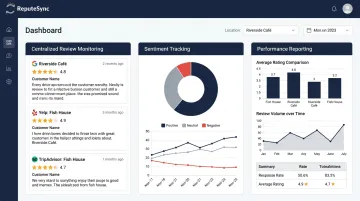
Restaurant-specific reputation management software exists precisely because generic tools weren't built for this. Repute Sync was designed around the restaurant industry's actual needs — centralizing review monitoring, automating review collection, and delivering the actionable insights owners need to understand what's driving customer sentiment and where they're losing guests.
When evaluating any reputation management platform for your restaurant, look for:
- Multi-platform review aggregation — one dashboard instead of six tabs
- Automated review requests — ethical, timed outreach that keeps your review count fresh
- Response workflow support — structured tools to help you respond consistently and on time
- Sentiment tracking over time — so you can see whether changes you make in the kitchen or front-of-house are actually registering with guests
- Performance reporting — ratings trajectory, sentiment trends, and clear visibility into whether things are improving
Repute Sync's onboarding follows a four-step process: demo call, review system implementation, active monitoring and response, and performance tracking. It's guided rather than self-serve — which matters for owners who need implementation support, not just software access.
You can learn more or book a demo at reputesync.com.
Frequently Asked Questions
What is brand and reputation management?
Brand and reputation management is the practice of monitoring, influencing, and protecting how a business is perceived publicly. It covers both proactive efforts — building a positive image through consistent quality and content — and reactive ones, such as addressing negative reviews or managing crises before they escalate.
What are the 3 C's of brand management?
Branding practitioner William Arruda's framework identifies Clarity, Consistency, and Constancy as the three pillars. For restaurants: clear messaging about what you stand for, consistent quality and voice across every touchpoint, and constant presence — showing up regularly so diners recognize and remember you.
What is the difference between SEO and ORM?
SEO (search engine optimization) focuses on ranking your content higher in search results. ORM (online reputation management) focuses on controlling what appears about your business in those results — particularly reviews and sentiment. For restaurants, both are tightly linked: your review volume and ratings influence your local search ranking directly.
How do I handle a negative restaurant review online?
Respond promptly, acknowledge the specific issue with empathy, avoid defensive language, and offer a resolution or invitation to return. If the situation is complex, invite the reviewer to contact you directly to take the conversation offline. Every future reader will see how you handled it.
How many reviews does a restaurant need to build trust with potential diners?
BrightLocal research found that 59% of consumers expect a business to have 20–99 reviews before trusting its average rating. Recency matters as much as volume. A steady stream of recent reviews signals an active, trustworthy business far better than a large but stagnant count.