Introduction
You're prepping for Friday night service. The reservation sheet is full. Then you refresh Yelp and see it — a 1-star review from Tuesday, already sitting at the top of your page. It calls your pasta overcooked and your server dismissive. Your stomach drops.
This moment happens to every restaurant owner. According to BrightLocal's 2026 consumer survey, 77% of consumers are less likely to choose a business after reading negative reviews. For restaurants specifically, industry research shows that 22% of diners won't visit after reading just one negative review.
The review itself isn't the disaster. Your response — or your silence — determines the real damage.
This guide covers exactly what to do: how to write a response that works, when removal is actually possible, and how to build a reputation strong enough to absorb the occasional bad night.
Key Takeaways
- Claim your Yelp for Business profile first — without it, you can't respond or flag any reviews
- Write public responses for future diners, not the reviewer who left the complaint
- Yelp only removes reviews that violate its content guidelines, not ones that are unflattering
- Organic review volume is your best long-term defense against any single 1-star review
- Consistent monitoring ensures no negative review slips through unaddressed during a busy week
Why Negative Yelp Reviews Hit Restaurants Harder
Restaurants aren't just overrepresented on Yelp — they're in a uniquely exposed position. According to Yelp's own Fast Facts, restaurants represent 16% of reviewed businesses on a platform averaging 28 million monthly app users. For a restaurant owner, that means thousands of strangers are reading your reviews before they've ever seen your menu.
The deeper issue is how dining decisions get made. Choosing a restaurant isn't like buying a product you can return. It's an experience — social, often celebratory, and impossible to evaluate before you commit. A single review warning about cold food or a rude host is enough to redirect a party of six to the place across the street. The risk calculus tips hard toward caution.
What compounds this is the visibility of silence. A restaurant that doesn't respond to negative reviews sends a clear message to every future diner reading that page: we don't care what you think. That signal does more damage than the original complaint.
A 2023 Yelp-commissioned survey of 2,000 U.S. adults found that 86% of review readers were more likely to overlook a critical review when the business responded and adequately addressed it. Responding isn't damage control — it's one of the most direct levers a restaurant owner has over how new diners perceive the business.
What to Do Before You Type a Single Word
The worst responses come from owners who react immediately. Here's the pre-response process that actually works.
Claim Your Profile First
If you haven't already claimed your Yelp for Business page at biz.yelp.com, do it now. Without a claimed profile, you cannot respond publicly, flag reviews, or access any management tools. Everything else in this guide depends on this step being done.
Pause Before You Draft
Don't write anything while you're angry or mid-service. An emotional, defensive response is permanent. Every future diner who lands on that review page will see it. Step away. The review will still be there in two hours.
Reconstruct What Happened
Before drafting a response, do the internal work:
- Speak with the server, kitchen team, or host involved
- Check reservation records and seating times
- Piece together the guest's actual experience
This context shapes a credible, specific response — and sometimes uncovers an operational gap worth fixing.
Categorize the Review
Every negative review falls into one of three categories, and each requires a different approach:
- Legitimate complaint — deserves a genuine, structured public response
- Suspicious or vague review — possibly fake; gather more context before responding
- Guideline violation — may qualify for removal via Yelp's flagging process
Once you know which category you're dealing with, drafting the right response becomes straightforward — and you avoid making a recoverable situation worse.
How to Write a Response That Actually Works
Your public reply isn't a conversation with the reviewer. It's a statement to every potential diner who will read that review page for the next three years. Write for that audience.
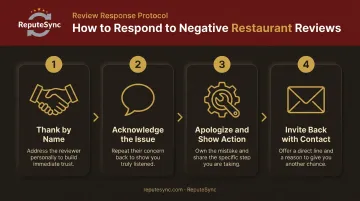
The Four-Part Response Structure
Every effective restaurant response follows this framework:
- Thank the reviewer by name — acknowledge that they took time to share feedback
- Acknowledge the specific issue — name the exact problem they raised, without excuses
- Apologize and mention corrective action — show what you've changed or are changing
- Invite them back with a direct contact — give an email or phone number and move the conversation offline
What to Leave Out
- Never offer discounts or comps in your public response — it looks like you're buying silence
- Never reference staff by name
- Never suggest the reviewer is wrong or exaggerating
- Never use a copy-paste template that ignores the specific complaint
A templated reply signals that no one actually read the complaint — and future diners notice that faster than you'd expect.
Timing
Aim to respond within 24–48 hours of the review being posted. BrightLocal found that 81% of consumers expect a response within one week, but waiting several days signals indifference. Draft the response, step away for an hour, then re-read with fresh eyes before posting.
Sample Response
Here's what a well-structured response looks like for a complaint about slow service:
"Thank you for sharing your experience, Marcus. You're right that the wait between courses on Saturday was longer than it should have been, and I'm sorry that affected your evening. We had a staffing change that night that created some gaps in timing — something we've since addressed with the team. I'd genuinely like the chance to make this right. Please reach out directly at [owner@restaurant.com] so we can take care of you on your next visit."
Every sentence earns its place: the problem is named, the fix is mentioned, and the conversation moves offline — where it's easier to resolve and less visible to everyone else reading.
When and How to Get a Negative Review Removed
Most negative reviews cannot be removed. Yelp evaluates policy violations, not whether a review is unfair or harsh. Knowing exactly what qualifies — and what doesn't — saves you from wasting time on flags that go nowhere.
Grounds for Removal
Yelp will consider removing reviews that fall into these categories:
- Conflicts of interest — reviews from competitors, current/former employees, or friends with a stake in the outcome
- No firsthand experience — hearsay, wrong-business reviews, or commentary unrelated to a real dining visit
- Inappropriate content — hate speech, threats, harassment, or lewd material
- Private information that improperly identifies individuals or exposes personal data
- Promotional content — reviews that are actually advertisements
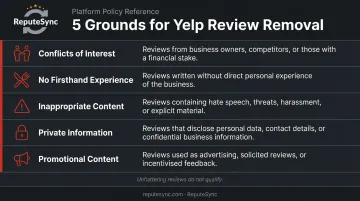
A review you simply disagree with, even if it feels exaggerated, does not qualify.
How to Flag a Review
- Log into Yelp for Business
- Navigate to Reviews
- Locate the review and click the three-dot More Options control
- Select Report Review
- Choose the most accurate violation category
- Write specific detail explaining which specific guideline is violated
Vague flags rarely succeed. Yelp's moderation team needs a clear, rule-based reason to act. The process typically takes several days, and you'll receive an email notification of the outcome.
After a Legitimate Resolution
Sometimes flagging isn't the right path — the complaint is valid, and you've already made it right. If you've genuinely resolved the guest's issue through a remake, refund, or follow-up conversation, it's appropriate to privately ask if they'd consider updating their review. Do this through a direct message or private channel, never in your public response. This works best when the resolution is real, not transactional.
When Removal Isn't Possible
If a review contains demonstrably false statements of fact (not just subjective opinions), it may meet the legal threshold for defamation. In that case, consult an attorney. For everything else: respond professionally and focus energy on generating more authentic positive reviews — one bad review carries far less weight when it's surrounded by dozens of good ones.
How to Build a Yelp Reputation That Can Absorb a Bad Review
A single 1-star review barely moves the needle for a restaurant with 150 reviews averaging 4.6 stars. For a restaurant with 20 reviews, that same 1-star drops the displayed rating noticeably. Volume is protection.
The Organic Review Approach
Yelp's policy is explicit: don't ask anyone to review your business — not customers, not mailing list subscribers, not friends or family. Yelp's recommendation software may exclude reviews that appear prompted, meaning direct ask campaigns can actively hurt your rating. Only recommended reviews count toward your displayed score.
What Yelp does permit:
- Linking to your Yelp profile from your restaurant's website
- Displaying a "Find us on Yelp" sign in your dining room
- Training staff to be aware of your Yelp presence — without asking for reviews directly
Ambient visibility does the work — no review collection campaign required.
Treat Negative Reviews as Operational Data
Negative reviews are operational signals, not just reputation problems. Recurring complaints about any of the following deserve a look at your processes:
- Wait times and table pacing
- Food temperature or consistency
- Portion sizes relative to price
- Service gaps during peak hours
Restaurants that track these themes and act on them see fewer repeat complaints. Referencing specific improvements in future responses also demonstrates accountability to prospective diners.
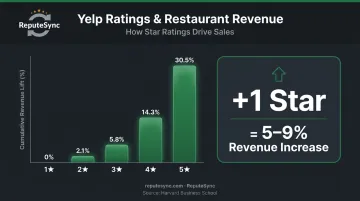
Research from Harvard Business School found that a one-star increase on Yelp is associated with a 5–9% revenue increase for independent restaurants. That's a direct line between reputation management and your bottom line.
Stay Consistent Across Platforms
That revenue impact makes consistent monitoring non-negotiable. A busy Saturday service is exactly when a negative review can go unnoticed for days — sometimes longer. Tools like Repute Sync let restaurant owners monitor, respond to, and track reviews across multiple platforms from a single dashboard. No review slips through during a rush.
Frequently Asked Questions
How do I respond to negative Yelp reviews?
Thank the reviewer, acknowledge the specific issue, apologize genuinely, and invite them to connect offline via email or phone. Remember: you're writing for future diners reading the exchange, so keep the tone professional and solution-focused.
Can negative Yelp reviews be removed?
Businesses cannot delete Yelp reviews themselves. Yelp will only remove reviews that violate its content guidelines — including hate speech, conflicts of interest, spam, and privacy violations. A review that's merely negative does not qualify for removal.
How long does Yelp take to remove a flagged review?
Yelp's moderation process typically takes several days. Once complete, both the reporter and the original reviewer are notified of the outcome: whether the review is removed or upheld.
Should I respond to old negative reviews?
Yes. Review pages are evergreen — potential diners read them at any time, regardless of when the review was posted. A professional response to a year-old review still demonstrates accountability and shows prospective customers how you handle problems.
What should I never say when responding to a negative review?
Never be defensive or accusatory, never offer public compensation in a way that looks transactional, and never send a generic copy-paste reply that ignores the specific complaint. Any of these make the restaurant look worse to future diners than the original review did.
Does responding to Yelp reviews actually help my reputation?
Yes. Consistent responses signal to potential diners that you value feedback and handle problems professionally. Research consistently links higher Yelp ratings to measurable revenue increases for independent restaurants, which means reputation management has a direct impact on your bottom line.