This guide covers what guest experience actually means in a restaurant context, maps the key touchpoints across the entire dining journey, and offers practical tips owners and managers can act on now.
Key Takeaways
- Guest experience spans every touchpoint — online discovery, reservation, the meal itself, and post-visit follow-up.
- Pre-visit friction and neglected post-visit follow-up are the two most overlooked gaps in the guest journey.
- Small personalized gestures and staff empowered to resolve complaints on the spot deliver outsized returns on loyalty.
- Your online reputation is shaped by each guest experience — and it directly influences whether future diners choose you.
What Is Guest Experience in a Restaurant?
Guest experience is the total emotional impression a diner forms across every interaction with your restaurant — from the moment they search for you online to how they feel a week after their meal. It's not just the food.
Black Box Intelligence defines guest satisfaction across five measurable components: food quality, service, ambiance, cleanliness, and value for money. None of these operates in isolation. A diner who had flawless food but couldn't get anyone's attention when they needed to flag an allergy will leave with a mixed impression at best.
Guest Experience vs. Guest Service
These two terms often get used interchangeably, but they describe different things:
- Guest service is reactive — answering questions, refilling water, resolving a complaint when it's raised.
- Guest experience is proactive and holistic — it's the sum of every touchpoint, including ones where no staff member is present, like your Google listing or your reservation process.
Great service is one component of great experience. You can have attentive servers and still deliver a poor overall experience if the booking process was frustrating or the follow-up never came.
The Three Core Elements
Understanding that distinction points to three elements that shape every guest's experience:
- Communication — how well you inform guests and genuinely listen to them, before, during, and after their visit
- Consistency — whether every visit reliably delivers the same quality; a guest who loved their Tuesday lunch needs to trust their Friday dinner will match it
- Personalization — making each diner feel individually valued, not just processed
Unlike hotels, where a guest might stay once a year, restaurants often see the same faces weekly. That frequency means a single inconsistent visit — or a moment where a regular feels unrecognized — can quietly undo months of goodwill.
Mapping the Restaurant Guest Journey
Guest experience doesn't begin at the door. It starts the moment someone searches for a place to eat. Understanding the three stages of the journey helps you identify where you're losing people and where you're winning them.
Pre-Visit: First Impressions Before They Walk In
The pre-visit stage covers everything a potential diner encounters before arriving: your Google listing, website, reservation process, and responsiveness to inquiries.
The data here is instructive. 44% of surveyed diners say difficulty booking makes a restaurant less appealing or causes them to abandon the attempt entirely, and 65% of diners who make reservations go directly to the restaurant's website to do so. A broken booking link or an unresponsive contact form doesn't just create friction. It hands a competitor a customer.
Pre-visit checklist:
- Google listing accurate and complete (hours, address, phone, photos)
- Website mobile-functional with a clear reservation path
- Inquiry responses within a few hours, not days
- Reviews visible and responded to (more on this below)
During the Visit: The Dining Experience Itself
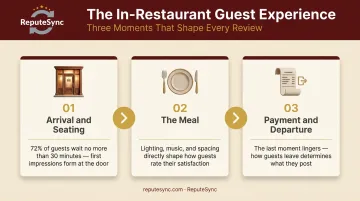
The in-restaurant experience breaks into three distinct sub-moments:
Arrival and seating — The greeting within the first 30 seconds, wait management, and the initial atmosphere impression set the emotional tone for the entire meal. 72% of diners will wait no more than 30 minutes for a table, meaning wait communication matters as much as wait time itself.
The meal — Server attentiveness, menu knowledge, food quality and pacing, and how dietary restrictions are handled. Research consistently finds that atmosphere has a stronger influence on guest satisfaction than either food quality or service — a reminder that the room your guests sit in matters more than many operators assume.
Payment and departure — A clunky checkout or an indifferent send-off undercuts an otherwise strong meal. The last impression lingers.
Post-Visit: The Experience Continues After They Leave
This is the stage most operators neglect. Post-visit touchpoints signal that you value the guest beyond the transaction.
Common post-visit touchpoints worth building into your routine:
- Follow-up emails asking for feedback (52% of diners are likely to respond when asked directly, per Toast data)
- Responding to reviews — positive and negative — within 24–48 hours
- Loyalty offers or return incentives tied to the visit
Simply asking is often enough. Restaurants that skip this step miss both the reviews and the repeat visits that follow.
Practical Tips to Elevate Every Dining Experience
Tip 1: Personalize Where It Counts
Train staff to note and act on guest information — birthdays, anniversaries, dietary preferences, a regular's usual order. Personalized gestures don't need to be elaborate. A complimentary dessert for a birthday or a server who says "the usual?" creates disproportionately strong emotional loyalty.
Toast's platform data shows that loyalty program enrollment is associated with a return rate rising from a 7% baseline to nearly 30%, with enrolled guests retaining at roughly 2x the rate of new customers. While that reflects loyalty enrollment broadly, the mechanism is the same: guests who feel recognized come back.
Tip 2: Own the First Two Minutes
How guests are greeted at the door, how quickly they're seated, and the opening interaction with their server sets the frame for everything that follows. Concrete steps:
- Establish a standard verbal greeting (not a script — a consistent, warm approach)
- If there's a wait, give a realistic time estimate immediately; ambiguity is more frustrating than the wait itself
- Have servers introduce themselves and cover specials within the first two minutes of seating
This stage is recoverable if something goes slightly wrong later. But a cold or chaotic arrival is hard to overcome.
Tip 3: Train Staff on the Menu Deeply
Servers who can explain ingredients, cooking methods, and allergen information — and make genuine recommendations — build guest confidence in ways that affect both safety and sales. Menu knowledge directly shapes allergy management, upsell effectiveness, and how professional your team appears.
Practical implementation:
- Conduct regular menu tastings so staff know what they're describing
- Require servers to know the top allergens in every dish
- Train on how to handle "I'm not sure" — a server who says "let me check with the kitchen" is far better than one who guesses
Tip 4: Build a Real-Time Complaint Process
A Cornell Hospitality study of 802 casual-dining patrons found that satisfaction with complaint outcomes correlated with intent to return at r = 0.42. That correlation only holds when the recovery is handled well. A lukewarm response does little.
Empowerment is the deciding factor. When front-of-house staff need to escalate every minor issue to a manager, the resolution feels slow and impersonal. Empower servers to:
- Offer a replacement dish without asking permission
- Apply a modest discount for a clear kitchen error
- Acknowledge the issue with genuine words, not a scripted apology
A guest who watches your team fix a problem in real time — calmly, without hand-wringing — leaves with a story about your restaurant that a flawless visit rarely produces.
Tip 5: Experience Your Own Restaurant as a Guest
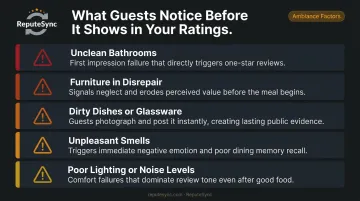
Lighting, noise levels, table spacing, cleanliness, and music are factors diners evaluate constantly. Restaurant managers rarely sit in the corner booth or the table next to the kitchen pass.
Schedule time monthly to sit in different areas of your dining room. Order from the menu. Wait. Notice what you notice. Black Box Intelligence's 2024 analysis identifies unclean bathrooms, furniture in disrepair, dirty dishes, and unpleasant smells as prominent negative ambiance themes in guest reviews — problems that are visible to guests long before they show up in your ratings.
Training Staff for Consistent Guest Experiences
Repeat guests come back because the experience feels reliable. That reliability doesn't happen by accident — it's built through deliberate, ongoing staff training.
One-time onboarding doesn't produce consistent behavior. Ongoing, scenario-based training does. Focus on three areas that matter most in real service moments:
- Role-play real scenarios: allergy questions, pressure-free upselling, handling a complaint from a guest who is already upset. Confidence in these moments comes from rehearsal, not instinct.
- Empower small decisions: staff who can comp a dish or offer a sincere gesture without radiating "I need to get my manager" resolve situations faster and more warmly.
- Solicit staff feedback: front-of-house employees hear the same complaints and requests repeatedly. Schedule brief, regular check-ins where staff can surface recurring friction points. Managers who rely solely on their own observation miss what's happening five tables away.
The goal is a team that handles the unexpected the same way every time. When staff have truly internalized the restaurant's standards, consistency shows up in the hard moments — not just the easy ones.
How Guest Experience Shapes Your Online Reputation
Every experience you create in your restaurant eventually surfaces online. Guests who feel genuinely delighted leave positive reviews without being asked. Guests who felt ignored during a complaint are motivated to document it publicly.
Michael Luca's foundational Harvard Business School study found that a one-star increase on Yelp was associated with a 5%–9% revenue increase for independent restaurants. For independent operators, this isn't a marginal effect — it's the difference between a thriving business and a struggling one.
Equally important: 66% of diners say they would consider returning after leaving a negative review if the restaurant responded and showed it cared. That response isn't just for the original reviewer. Every potential diner who reads your Google listing sees how you handle criticism.
Managing the review cycle proactively, then, becomes inseparable from managing the dining experience itself. Monitoring reviews across platforms, responding promptly, and collecting feedback systematically all require infrastructure few operators have built out.
Repute Sync was built to address exactly that gap. Research behind the platform shows that a meaningful share of customers lost to negative reviews won't return without proactive outreach — and that's the problem Repute Sync is designed to solve. The platform gives restaurant owners:
- Automated review collection across major platforms
- Cross-platform monitoring from a single dashboard
- Professional response tools for handling criticism publicly
- Sentiment tracking to spot problems before they compound
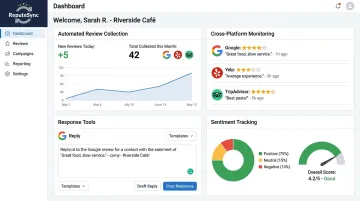
That combination lets operators treat reputation management as an ongoing system, not a reactive scramble.
Frequently Asked Questions
What is the meaning of guest experience?
Guest experience is the overall emotional impression a person forms across every interaction with a business. In a restaurant, this spans from discovering the restaurant online through to post-dining follow-up — not just what happens at the table.
What are the three elements of guest experience?
The three core elements are Communication (keeping guests informed and listened to), Consistency (delivering the same quality every visit), and Personalization (making each guest feel individually valued). Each element reinforces the others — weakness in any one area undermines the whole impression.
What is an example of a guest experience?
A server who remembers a regular's dietary restriction, proactively flags an ingredient in a new dish, and then the restaurant sends a thank-you message after the meal. No single touchpoint stands out on its own, but the combination is what guests remember and return for.
What is the difference between guest service and guest experience?
Guest service refers to specific direct interactions — refilling water, answering questions, resolving a complaint. Guest experience is the broader perception formed across all touchpoints, including the reservation process, ambiance, food quality, and post-visit communication.
How do online reviews affect restaurant guest experience?
Online reviews are both an outcome of guest experience (satisfied guests leave positive reviews) and an input to future experience (potential diners read reviews before choosing a restaurant). That feedback loop means your reputation management directly shapes the guests you attract next.