Most restaurant owners know they should "respond professionally." The gap is in execution — what to say, when to flag instead of respond, and how to prevent the next bad review from landing the same way.
This guide covers all of it: a step-by-step response process, when to flag a review for removal, what to have ready before a bad review hits, the factors that determine whether your response helps or hurts, common mistakes to avoid, and proactive strategies to strengthen your overall review profile.
Key Takeaways
- Respond within 24–48 hours, before undecided diners move on to a competitor
- Address the specific complaint, not a generic version of it
- Move complex situations offline; never argue publicly
- Flag reviews that violate platform policies rather than responding to them
- A strong review volume means one bad rating won't define your restaurant
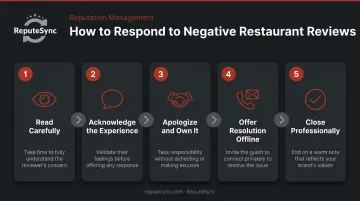
How to Respond to a Negative Restaurant Review: Step by Step
Your response is public. Every potential diner reading the original complaint will also read what you wrote. An inconsistent or emotional reply amplifies the damage instead of limiting it. A structured approach keeps you consistent across every platform and every complaint type.
Step 1: Read the Review Carefully Before Doing Anything
Resist the impulse to fire back immediately. Read the review twice. Identify the actual complaint — food quality, wait time, a specific server, cleanliness — so your response addresses what the customer experienced, not what you assume they meant.
Also assess whether the review is legitimate, a misunderstanding, or potentially fake. That assessment determines whether you respond or flag.
Step 2: Acknowledge the Experience Without Being Defensive
Start with a genuine acknowledgment of the specific issue. Compare these two openers:
- Generic: "We're sorry you had a bad experience."
- Specific: "We're sorry the wait time on your visit didn't meet expectations — that's not the experience we aim to deliver."
The second version signals you actually read the review. Even if the complaint is partially inaccurate, do not argue or shift blame publicly. Your tone tells future diners how you handle things when something goes wrong.
Step 3: Apologize and Take Ownership
Offer a sincere apology that fits the situation. If the complaint is valid, own it clearly. If details are disputed, apologize for the experience without conceding specifics you can't verify.
Keep this part brief and human. Copy-paste apologies read as insincere, and returning customers who've seen your responses before will notice immediately.
Step 4: Offer a Resolution and Invite the Conversation Offline
Give a direct next step: a manager's email address, a phone number, or a specific invitation to return. Vague closings like "please reach out to us" without contact details don't demonstrate genuine willingness to resolve anything.
Moving emotionally charged situations to a private channel protects you from a public back-and-forth while still showing accountability.
Step 5: Close Professionally and Keep It Concise
End with the restaurant's name and the manager's or owner's first name. Personalization matters. Keep the total response under 150 words — long responses over-explain, and that rarely helps your case with the reader watching from the sidelines.
When to Flag a Review for Removal Instead of Responding
Not every negative review needs a response. Some violate platform policies and can be flagged for removal — a process separate from replying.
Reviews that qualify for flagging across major platforms:
| Violation Type | Yelp | TripAdvisor | OpenTable | |
|---|---|---|---|---|
| Fake or spam content | ✓ | ✓ | ✓ | ✓ |
| Conflict of interest (competitor/ex-employee) | ✓ | ✓ | ✓ | — |
| Off-topic or irrelevant content | ✓ | ✓ | ✓ | — |
| Offensive or hateful language | ✓ | ✓ | ✓ | ✓ |
| Impersonation | ✓ | — | ✓ | ✓ |
Platforms evaluate every flagging request and may decline it. A low rating alone — even an unfair one — is not a policy violation. Google, Yelp, and TripAdvisor make clear they do not remove reviews simply because a business disputes their accuracy.
While a removal request is under review, post a brief professional response anyway. An unanswered review tells potential diners the restaurant doesn't care enough to respond.
What Every Restaurant Needs in Place Before a Bad Review Hits
Reactive management is always more expensive than proactive management. Restaurants that figure out their response process after a damaging review appears respond slower, less consistently, and with less professionalism than those with a plan already built.
Build these three things before the next review lands:
A written response protocol covering who monitors reviews, what tone to use, and what approvals are needed before posting. If three staff members respond with three different voices, your review page looks unmanaged.
A platform monitoring list — at minimum: Google, Yelp, TripAdvisor, OpenTable, and Facebook. According to Toast's data, 46% of diners check Google first for restaurant ratings, versus 23% for Yelp — but gaps on either platform cost you.
Response templates for common complaint types: food quality, service, wait times, order errors. Treat them as starting points — personalize each one, never copy verbatim.
For multi-location operators, manual monitoring across all these platforms becomes error-prone fast. Repute Sync was built specifically for this — it consolidates review monitoring and response management across Google, Yelp, TripAdvisor, and more into a single dashboard, so no location and no review slips through. If your team is already stretched thin on tracking, that's the gap to close first.
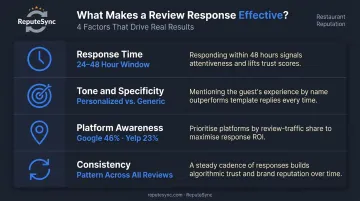
Key Factors That Shape How Well Your Response Lands
Two restaurants can follow the same basic steps and get different outcomes. These four factors explain most of the gap.
Response Time
Speed matters more in the restaurant space than in most industries because dining decisions happen fast. ReviewTrackers' 2022 local consumer report found that 53% of consumers expect a response to a negative review within one week, and one in three expect it within three days. A practical internal benchmark for restaurants is 24–48 hours — not because it's a verified consumer threshold, but because diners making same-week decisions may see an unanswered review and move on before you've had a chance to respond.
Tone and Specificity
Generic responses signal that no one actually read the complaint. Specific responses — those that name the issue, reference the visit, and address what went wrong — signal attention and care. That signal is read not just by the original reviewer but by every potential diner scrolling through your reviews afterward.
Platform Awareness
The audience differs by platform. Yelp tends to attract more experienced reviewers who read business responses closely. Google reviewers skew more casual, but Google is where 46% of diners check first — making it the highest-priority platform for response visibility. Knowing where your response lives shapes how you write it.
Consistency Across All Reviews
One excellent response to a critical review can be undone if you ignore five others. A consistent response pattern — across both positive and negative reviews — signals that someone is actively managing the restaurant's reputation. Diners researching your restaurant scan the full review history. A string of unanswered complaints tells its own story, regardless of how strong any single response is.
Common Mistakes Restaurants Make When Handling Negative Reviews
Getting Defensive or Arguing Publicly
Even when a restaurant is clearly in the right, public disputes with reviewers read badly to outside observers. Other diners interpret conflict as a sign of poor customer relations — regardless of who started it. Defensive responses deflect; they don't repair. If a review is genuinely false or defamatory, that's a flagging situation, not a public argument.
Using Copy-Paste Responses Across All Reviews
Templates are useful starting points. They become liabilities when deployed without any personalization. Regular visitors and frequent review-readers notice repeated identical language — and they interpret it as indifference. Personalize every response, even if the structure stays consistent.
Ignoring the Review Entirely
Non-response has a measurable cost. BrightLocal's 2024 local consumer survey found that 88% of consumers would use a business that replies to all reviews, compared to just 47% for a business that never replies. That gap represents real lost traffic.
The pattern holds at the individual restaurant level too. Repute Sync's platform data shows that 30% of customers lost to negative reviews won't return without proactive outreach — meaning no response isn't a neutral choice; it's an active one with a measurable price tag.
How to Proactively Build a Stronger Review Profile
Long-term reputation management isn't just about handling bad reviews — it's about building a profile resilient enough that one or two negative reviews don't define your overall rating. Volume and recency both matter.
Practical, ethical ways to encourage satisfied diners to review:
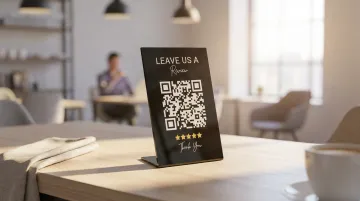
- Place table cards with a QR code linking directly to your Google or Yelp review page
- Send a post-visit follow-up via email or SMS while the experience is still fresh
- Train staff to briefly mention it at checkout — something as simple as "If you enjoyed your meal, we'd love a review on Google"
Platform rules to know before you ask:
- Google permits asking customers for reviews and sharing a review link. Offering incentives or selectively soliciting only positive reviews is prohibited.
- Yelp is stricter: its official guidance states "Don't ask anyone to review your business." Use approved "Find us on Yelp" materials instead of direct solicitation.
Staying consistent with these outreach methods is where many busy restaurants fall short. Automation closes that gap. Repute Sync's automated review collection system prompts satisfied diners after a visit while the experience is still fresh, keeping a steady flow of new reviews coming in. Over time, that volume dilutes the impact of any single negative review — so your rating reflects the full picture of your restaurant, not just the loudest complaints.
Frequently Asked Questions
How do I deal with negative online reviews?
Read the review carefully, identify the specific complaint, then respond promptly and professionally. Acknowledge the issue, offer a resolution, and move complex situations to a private channel. Reputation is built one response at a time, so consistency across every platform is what compounds into trust.
Can you get sued for leaving a negative online review?
Honest opinions about a dining experience are generally protected speech. Legal risk arises when a review contains demonstrably false statements of fact — for example, fabricating a health violation that didn't occur. Defamation law varies by jurisdiction and is fact-dependent, so consult a lawyer familiar with your jurisdiction if you're unsure.
Should restaurants respond to every negative review, even old ones?
Recent reviews should always take priority, but older unanswered negative reviews remain visible to future diners. Responding to them belatedly is still better than leaving them unaddressed — it demonstrates accountability regardless of timing.
Can I ask Google or Yelp to remove a negative restaurant review?
Yes, reviews can be flagged when they violate platform policies — spam, fake content, conflicts of interest, offensive language. Platforms evaluate each request individually, and removal is not guaranteed. Post a professional response while the flag is under review so the complaint doesn't sit unanswered.
How quickly should a restaurant respond to a negative review?
Aim for within 24–48 hours. Faster responses signal attentiveness and shrink the window during which potential diners see an unanswered complaint. Most dining decisions happen within the week, so a late response can cost you a real table.
Do negative reviews hurt a restaurant's ranking on Google?
Google confirms that more reviews and positive ratings can improve local search ranking. A pattern of negative reviews with no responses signals low engagement. Consistent replies and growing review volume support stronger local visibility, though Google doesn't publish exact weights for individual ranking factors.