Introduction
Most diners make up their minds before they ever walk through your door. According to Toast's 2024 survey of over 1,100 U.S. diners, only 18% say they never or rarely check online ratings before deciding where to eat — meaning the vast majority consult reviews as a standard part of their decision process.
Yet most restaurant owners have no consistent system for collecting them. Reviews trickle in when they happen to, skewed heavily toward unhappy guests who are motivated to vent. Repute Sync's platform data shows that 30% of lost customers don't return when restaurants take no action on their online reputation — a gap that widens every week you're not actively building your review pipeline.
This guide covers both in-person and digital tactics you can implement immediately, from training your staff to automating follow-ups after every visit. By the end, you'll have a clear framework for collecting fresh, authentic reviews across the platforms that drive real foot traffic.
Key Takeaways
- Google, Yelp, and TripAdvisor are where diners check ratings first; prioritize them in that order
- In-person asks from staff outperform mass digital messages when timing and tone are right
- SMS and email follow-ups work best within 24 hours of the visit
- Review recency matters as much as volume — treat collection as an ongoing habit, not a campaign
- Responding to reviews publicly encourages more guests to leave their own
Why Online Reviews Are Make-or-Break for Restaurants
They Drive How Easily Diners Find You
Google confirms that review count and review score factor directly into local search rankings. More reviews, and more positive ones, improve where your restaurant appears when someone nearby searches "best tacos near me" or "Italian restaurant open now." For any independent restaurant competing without a marketing budget, that organic visibility is what puts you in front of diners before they ever see your menu.
And ratings don't just affect discoverability — they filter out restaurants entirely. Toast's survey found that:
- 26% of diners won't consider a restaurant below 3 stars
- An additional 17% draw the line at 3.5 stars
A thin or outdated review profile costs you rankings — and it removes you from the decision entirely before a diner even clicks through.
Stale Reviews Stop Working
Volume alone isn't enough. According to BrightLocal's consumer research, 74% of consumers specifically seek reviews written within the last three months. A restaurant sitting on 200 reviews with nothing recent reads as inactive or unreliable — even if the reviews themselves are positive.
For first-time diners with no personal experience to fall back on, peer reviews serve as a proxy for trust. A competitor with 60 fresh reviews will outperform you with 300 stale ones. This is why review collection has to be continuous, not a one-time push.
Which Review Platforms Should Restaurants Prioritize
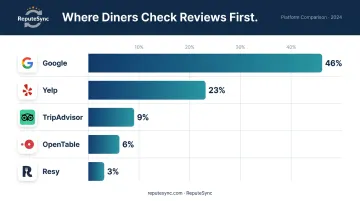
Not all platforms carry equal weight. Toast's survey of recently active U.S. diners is clear on where to focus:
| Platform | % Who Check It First |
|---|---|
| 46% | |
| Yelp | 23% |
| TripAdvisor | 9% |
| OpenTable | 6% |
| Resy | 3% |
Google Business Profile — Start Here
Nearly half of diners go to Google first. That makes your Google Business Profile the single highest-leverage asset for local discoverability. Before you ask anyone for a review, claim your profile, fill out every field, and add current photos. A sparse or unclaimed profile undercuts even great reviews.
Yelp and TripAdvisor
Yelp is second in diners' first-check behavior and has its own actively engaged dining audience. One important cultural note: Yelp explicitly discourages businesses from soliciting reviews. The better approach is creating an experience worth reviewing, then making your profile easy to find — through QR codes on receipts, for example, without a direct "please leave us a Yelp review" ask.
TripAdvisor may rank third in first-checks, but its scale is substantial. Restaurant reviews accounted for over 40% of TripAdvisor's 31.1 million review submissions in 2024 — and for the first time, restaurant reviews exceeded accommodation submissions. For restaurants with any tourist or out-of-town traffic, that reach makes it a platform worth actively maintaining.
OpenTable, Resy, and Facebook
These platforms are supplementary, but each serves a distinct purpose worth covering:
- OpenTable: The Dining Feedback program restricts reviews to guests who completed a verified reservation — that built-in verification makes reviews harder to dismiss as fake, and skeptical diners notice.
- Facebook: Reviews here reach people who discover you through local community groups or social ads, a different discovery path than search-first behavior.
- Resy: Smaller overall share, but maintaining an active profile keeps you visible to the booking-app crowd that skips Google entirely.
Proven In-Person Review Collection Strategies
Empower Your Staff as the Front Line
Your servers and hosts are the most natural conduit for a review request. The difference between a request that feels warm and one that feels scripted comes down to two things: timing and context.
Train front-of-house staff to extend invitations after a genuinely positive interaction — not as a scripted checkout step. A server who just watched a table light up over a dish can say, "I'm so glad you loved it — if you have a moment, we'd really appreciate hearing that on Google." That feels personal in a way a laminated card handed with the bill never does.
A simple internal system makes this consistent. When a manager flags a table that's had an exceptional experience, the server gets a natural cue to close with a genuine ask — rather than applying the same pitch to every table regardless of how the meal went.
QR Codes and Table-Level Prompts
QR codes reduce friction between intent and action. Placement matters — put them where diners are still engaged, not on the way out the door:
- Table tents or menu inserts
- Check presenters
- Takeout packaging and receipt slips
Timing is the key variable. A QR code prompt works best when the diner is still at the table, satisfied, and mentally in the experience — during coffee or dessert, not as they're putting on their coats.
Keep the message short: one sentence, one ask, one link. "Loved your meal? Share it here →" is enough.
Digital Review Collection: Reaching Guests After They Leave
Post-Visit Email Follow-Up
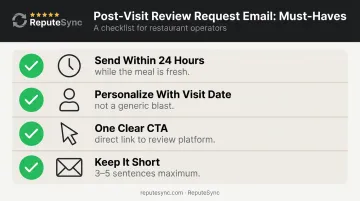
Restaurants that take reservations or online orders have access to guest emails — a channel worth using carefully. An effective post-visit review request email has a few non-negotiable traits:
- Sent within 24 hours while the meal is still fresh
- Personalized with the visit date (not a generic blast)
- One clear CTA linking directly to the review platform
- Short — three to five sentences, no more
Don't ask for a review and a satisfaction survey in the same message. Split those asks. Mixing them dilutes both. Test subject lines — even a modest improvement in open rate compounds over hundreds of emails per month.
SMS Review Requests
Text messages have a far higher open rate than email — CTIA reports the industry-wide figure at 98%. For review requests sent within a few hours of a visit, SMS can outperform email significantly, though the two channels serve different segments of your guest base.
A few compliance requirements that aren't optional:
- Guests must provide explicit opt-in consent before you text them
- Build that opt-in into your reservation flow, online ordering, or loyalty sign-up
- Always support standard opt-out requests (STOP commands)
- Keep messages identified — guests should know immediately who's texting them
A simple SMS that uses the guest's first name, thanks them, and includes a direct review link is all you need.
Automating Review Requests Across Platforms
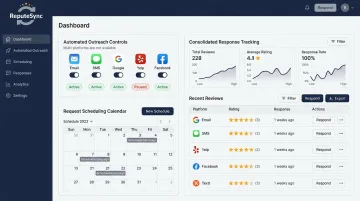
Manually following up with every guest isn't realistic for a restaurant running on tight margins and limited staff bandwidth. Repute Sync automates review request outreach across multiple platforms from a single dashboard, so every guest interaction generates a follow-up — not just the ones a staff member remembered to flag.
The real gain is consistency. Requests go out at the right time, every time, without adding to anyone's workload. Human variability drops out of the equation entirely.
Leveraging Reservation Platform Follow-Ups
OpenTable and Resy automatically send post-dining emails to guests — but most restaurant owners never look at what those messages actually say. That's a missed opportunity.
Where customization is allowed, a few small adjustments make a real difference:
- Adjust the default tone to feel less transactional
- Add a clear, direct prompt asking for a review
- Reference the specific dining experience where possible
Verified-reservation reviews carry extra credibility because the platform confirms the guest actually dined. Collecting more of them is worth the five minutes it takes to update your messaging settings.
Timing and Frequency: When and How Often to Ask
Getting the timing right matters as much as the ask itself.
Optimal window: Within a few hours to 24 hours after the visit. Sentiment is warm, the experience is specific in the guest's memory, and they're more likely to write something useful. Waiting 48 to 72 hours cuts response rates noticeably.
For first-time or infrequent guests: Ask once per visit. They're not fatigued, and the experience is novel enough to generate a genuine response.
For loyal regulars: Space requests out. Asking a weekly regular after every visit trains them to ignore you. Building in logic that suppresses requests until every third or fifth visit keeps the relationship genuine. If you're using an automated tool like Repute Sync, this kind of cadence control removes the guesswork entirely.
On recency: Think of review collection like restocking mise en place — it's an ongoing operational habit, not a one-time project. A restaurant with 500 reviews and nothing recent loses to a competitor with 80 reviews and daily fresh feedback.
How Responding to Reviews Multiplies Your Collection Efforts
Responding to reviews does more than manage your reputation. It actively encourages future reviews.
BrightLocal's research found that 88% of consumers would use a business that responds to all reviews, and 93% expect a response when they leave one. When a first-time visitor sees that every reviewer — positive or critical — received a thoughtful, specific reply, they trust the business more. They're also more inclined to leave their own review, knowing it won't disappear into a void.
A 2025 academic study using a difference-in-differences design found that a higher ratio of management responses to positive reviews correlated with increases in both subsequent ratings and restaurant revenue. Responses signal that the owner is present, accountable, and genuinely engaged with guests — and diners notice.
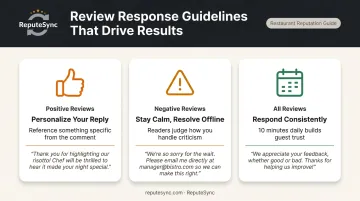
Practical guidelines for responses that drive results:
- Personalize positive replies by referencing something specific from the comment — "Glad the duck confit hit the mark" beats a generic "Thanks for visiting!" every time
- Acknowledge negative feedback without getting defensive; offer to resolve offline, because other readers are judging how you handle criticism more than the complaint itself
- Respond consistently — sporadic engagement signals selectivity; set aside 10 minutes daily and build it into your routine
Frequently Asked Questions
What is review collection?
Review collection is the intentional process of requesting and organizing customer feedback through email, SMS, in-person asks, or automated tools. Unlike reviews that arrive on their own, collection creates a consistent, manageable flow of new feedback across platforms.
What is a review collector?
A review collector is a tool, platform, or system — automated or manual — that a business uses to request and aggregate customer reviews from one or more review sites into a manageable workflow. Repute Sync is an example: it handles outreach and consolidates responses across multiple platforms from one dashboard.
What are the main types of reviews restaurants receive?
The primary categories are star ratings with written comments (Google, Yelp), platform-verified dining reviews (OpenTable, TripAdvisor), and social media mentions or recommendations. Verified reviews carry the most credibility with prospective guests because the platform confirms the guest actually visited.
How do I ask customers for reviews without being pushy?
Timing and tone are everything. Ask after a genuinely positive interaction — not at checkout as a scripted obligation. A warm, personal invite from your server after a great meal will always outperform a generic printed card.
Which review platforms matter most for restaurants?
Prioritize these platforms based on impact:
- Google Business Profile — highest priority for local search visibility
- Yelp and TripAdvisor — strong reach with dining-focused audiences
- OpenTable and Resy — reservation-verified reviews that carry extra credibility
How often should restaurants ask customers for reviews?
Once per visit works well for first-time or infrequent guests. For loyal regulars, space requests out — every three to five visits — to avoid fatigue. A steady stream of fresh reviews, even at modest volume, carries more weight with search algorithms than occasional spikes.