Introduction
A diner searching for somewhere to eat tonight isn't spending much time deliberating. They open Google Maps, scan ratings, skim recent reviews, and make a decision in minutes. According to a 2024 restaurant diner survey, 91% of diners call ratings and reviews decisive, and 71% have rejected a restaurant outright after reading negative feedback.
That's not a soft preference. It's revenue lost before you ever had a chance to serve them.
Negative reviews are inevitable in any restaurant. What separates thriving operators from struggling ones isn't the absence of bad reviews — it's what they do next. Most owners ignore the feedback, fire back defensively, or assume there's nothing they can do. Each of those responses carries real costs: in foot traffic, in search visibility, and in customers who quietly walk to a competitor instead.
The operators who handle this well don't get fewer bad reviews — they just get better at making those reviews matter less. Here's how.
Key Takeaways
- Reply to every legitimate negative review within 24 hours — keep it personalized, not templated
- Before responding or reporting, determine whether a review is fake or a genuine complaint
- Recurring complaints reveal fixable problems — repeated mentions of wait times or food quality are operational signals, not just bad luck
- A strong volume of positive reviews dilutes the impact of individual negative ones
- Monitor all platforms from one place — fragmented tracking slows responses and lets complaints go unanswered
Why Negative Reviews Hit Restaurants Harder Than Most Businesses
Restaurant decisions are local, impulsive, and comparison-driven. A couple deciding between two nearby spots on a Friday night will almost certainly pick the one with better recent reviews — not the one with a longer history or a slightly better menu. That recency bias matters: 64% of diners focus on reviews less than one month old, and 78% consider only reviews from the past three months.
The Most Common Triggers
Restaurant-specific complaints tend to be emotionally charged because food and service are personal. The most common triggers:
- Food arriving cold, overcooked, or nothing like the menu description
- Service that feels inattentive — diners being ignored, forgotten, or rushed
- Wait times that weren't communicated upfront
- Cleanliness issues in restrooms, at tables, or near visible kitchen areas
- Wrong dishes, missing items, or dietary requests that were ignored
- Feeling like the price didn't match the experience
These complaints hit hard because they're specific, emotional, and easy for other diners to picture happening to them.
The Platform Visibility Problem
On Google, Yelp, TripAdvisor, and OpenTable, a cluster of fresh negative reviews doesn't just shape opinion — it affects ranking. Google confirms that review count and score factor into local search ranking, meaning a restaurant hit by a wave of bad feedback can lose discoverability at the exact moment it needs new customers most.
That combination — emotional triggers, recency bias, and platform penalties — is exactly why responding to negative reviews quickly and deliberately isn't optional for restaurants. It's a business survival skill.
Monitor Reviews Across All Restaurant Platforms
You can't respond to what you don't see — and manual checking is too slow to be effective.
Platforms That Require Active Monitoring
- Google Business Profile — the highest priority; 46% of diners check Google first for restaurant ratings
- Yelp — second at 23%, with its own recommendation algorithm and filtering behavior
- TripAdvisor — 9% of diners check here first, critical for tourist-heavy areas
- OpenTable — 6% use it as their primary source; reservation-linked reviews carry weight
- Facebook — community-driven feedback with strong local reach
- Delivery platforms — DoorDash, Grubhub, and Uber Eats ratings are visible to anyone browsing
Logging into each platform individually isn't realistic for a busy operator — and the delay has a real cost.
The Cost of a 48-Hour Gap
A negative review that sits unanswered for two to three days is seen by every prospective diner during that window with no counter-narrative. Weekend dinner searches, lunch-hour decisions, event planning — all of it happens while a 1-star review sits at the top of your profile unchallenged.
Real-time alerts eliminate that gap. Repute Sync aggregates reviews from multiple sources into a single dashboard with instant notifications, so restaurant owners know the moment a new review goes live — no cycling through six separate logins required.
How to Respond to Negative Restaurant Reviews Publicly
Timing Is Part of the Message
Responding within 24 hours signals something specific to future readers: this restaurant pays attention. It also gives you the best chance of recovering the original reviewer. 66% of diners said they would consider returning to a restaurant if the restaurant responded and showed it cared — but that window closes fast if days go by with silence.
The Anatomy of an Effective Response
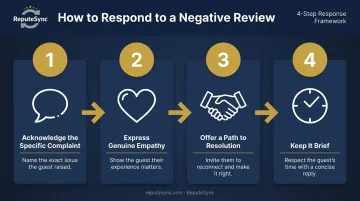
A good public response has four components:
- Acknowledge the specific complaint — not a generic "sorry you had a bad experience"
- Express genuine empathy — without being defensive or making excuses
- Offer a path to resolution — what you'll do, or invite them to contact you directly
- Keep it brief — three to five sentences is enough
Example — food quality complaint:
"Thank you for telling us about this, [Name]. A dish arriving cold is never acceptable, and we're sorry your evening didn't meet the standard we hold ourselves to. We'd love the chance to make it right — please reach out to us at [email/phone] so we can take care of you personally."
Example — service complaint:
"We're sorry your server left you feeling overlooked — that's not the experience we want anyone to have here. We're taking your feedback directly to our team. If you're open to it, please contact us at [email/phone] and we'd like to make it right."
Mistakes That Cost You Future Diners
Most bad responses share one of these patterns:
- Getting defensive — arguing with the reviewer or disputing their account publicly
- Making excuses — "we were unusually busy that night" reads as deflection, not accountability
- Copying and pasting the same response to every review is immediately visible and signals you don't actually read the feedback
- A survey found 77% of diners expect restaurants to respond to reviews — not responding is itself a statement
Write for the Audience, Not the Reviewer
The specific person who left the review may never return regardless of what you say. Your response is actually for the hundreds of prospective diners who will read that exchange when considering your restaurant. Every response is a public demonstration of how you handle problems — and that shapes whether a first-time visitor decides to book a table.
Assign the Response Function
Food and service reviews feel personal to owners who built the restaurant from scratch. Responding in that emotional state leads to exactly the defensive tone that damages reputation further.
Designate a manager or operations lead to handle review responses. Draft replies before posting. Even a 30-minute pause before hitting publish prevents the kind of responses you'll regret.
- Boilerplate replies — copying and pasting the same response to every review is immediately visible and signals you don't actually read the feedback
- Silence — a survey found 77% of diners expect restaurants to respond to reviews; not responding is itself a statement
Handling Fake and Malicious Restaurant Reviews
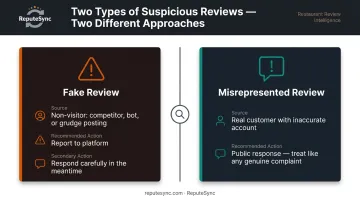
Two Types, Two Different Approaches
Not every suspicious review fits the same mold — and the distinction matters for how you respond.
| Type | Source | Your Move |
|---|---|---|
| Fake review | Never visited — competitors, bots, personal grudges | Report to the platform; respond carefully in the meantime |
| Misrepresented review | Real customer, inaccurate or exaggerated account | Public response, same as any genuine complaint |
How to Report a Review on Google Business Profile
- Go to your Business Profile and open Read reviews
- Find the review and select Report issue
- Choose a violation category — spam, conflict of interest, off-topic, fake or misleading content
- Submit the report
Google's review evaluation process typically takes several days. You can check status through the Reviews Management Tool. If Google's initial decision is to keep the review, a one-time appeal is available — you can select up to 10 reviews for appeal and submit an appeal form. An emailed decision follows.
Responding Publicly to Suspected Fake Reviews
Avoid accusing the reviewer outright. A response like "This is clearly a fake review from a competitor" may feel satisfying but looks unprofessional to everyone reading it.
Instead: "We have no record of this visit and would like to understand what happened. Please reach out to us directly at [email] so we can look into this."
That response is factual, non-escalatory, and signals to future readers that you take complaints seriously — even ones that appear suspicious.
Resolve the Issue Privately and Request an Updated Review
After posting a public response, the next step is a private follow-up. Use the platform's messaging system or the contact email you included in your response. The goal is to understand the full complaint and offer something genuine:
- A replacement meal or complimentary dish
- A partial or full refund
- A personal invitation to return and try again
Once the concern is resolved, it's acceptable to ask — without pressure — whether the customer would consider updating their review. A reviewer who initially left 2 stars and was then treated with real care and follow-through may revise to 4 stars. That revision is visible to every future reader and carries more credibility than any marketing copy.
Set realistic expectations: not every dissatisfied diner will respond to outreach, and not every update request leads to a change. What matters is demonstrating a consistent pattern of accountability — one that future diners notice and trust.
Turn Negative Feedback Into Better Operations and More Positive Reviews
Complaints as Operational Data
A single complaint about slow service on a Saturday night might be an anomaly. Five complaints over two months about the same issue is a pattern — and patterns are fixable.
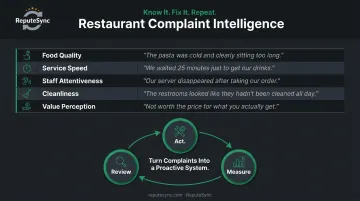
Categorize recurring complaints by theme:
| Category | Example Complaint Signal |
|---|---|
| Food quality | "The steak was overcooked and cold" |
| Service speed | "Waited 45 minutes for our entrees" |
| Staff attentiveness | "Our server disappeared after taking our order" |
| Cleanliness | "The restroom was not clean" |
| Value perception | "Not worth the price for what you get" |
Bring these patterns into weekly team reviews. Connect complaint categories to specific shifts or time periods. Track whether the frequency drops after a staffing or kitchen change. That loop — review, act, measure — turns a reactive problem into a proactive system.
The Volume Dilution Strategy
The most durable protection against negative reviews is a large number of genuine positive ones. A restaurant with 500 reviews averaging 4.4 stars is far more resilient than one with 40 reviews at 4.6 — both because the math absorbs individual bad reviews and because volume signals credibility to new diners.
A 2020 study of U.S. casual-dining brands found review volume was positively associated with customer share of visits, while rating alone was less predictive at the individual location level.
Practical Ways to Grow Review Volume
- Train servers to mention reviews at the close of a clearly positive interaction — not as a script, just a natural nudge
- Add a QR code linked to your Google review page on receipts, table tents, or takeout bags
- Send a review request to loyalty program members after a visit — 52% of diners said they were likely to leave feedback when asked
- Keep requests neutral; neither Google nor Yelp permits incentivizing reviews or selectively asking only satisfied customers
Note that Google and Yelp have different policies here. Google permits neutral review requests and QR codes. Yelp advises businesses not to solicit reviews at all — even from happy customers. Keep those approaches separate.
Tools like Repute Sync handle this automatically — sending review requests after a dining visit across Google, Yelp, and other platforms without requiring manual follow-up from your team. For restaurants managing high daily volume, that consistency is hard to replicate without automation.
Frequently Asked Questions
How do you manage negative restaurant reviews?
Monitor all major platforms daily for new reviews, then respond publicly within 24 hours with a specific, professional reply. Follow up privately to resolve the complaint where possible, and focus consistently on generating positive reviews to build a resilient overall rating.
Can a restaurant owner remove a negative review?
No — owners cannot delete reviews they simply disagree with. Reviews that violate platform policies (spam, fake content, off-topic, profanity) can be reported to Google or Yelp for potential removal. Legitimate reviews from real customers require a professional response and resolution, not removal.
How quickly should a restaurant respond to a negative review?
Within 24 hours. A fast response signals accountability to both the reviewer and every future diner who reads the exchange — leaving it unanswered lets the complaint define you.
What should a restaurant say in a negative review response?
Acknowledge the specific complaint, express genuine empathy, offer a path to resolution, and invite further conversation offline. Avoid defensive language, generic apologies, or any response that reads as making excuses.
How do negative reviews affect a restaurant's business?
71% of diners have decided not to visit a restaurant after reading negative reviews — a direct hit to foot traffic and revenue. Review volume and scores also factor into local search rankings on Google, affecting how often the restaurant surfaces when nearby diners are searching.