The problem is that most restaurants treat reviews as something that just happens. A few satisfied guests leave feedback, a few unhappy ones do too, and the rating settles wherever chance takes it. That's not a strategy — it's a gamble.
According to Toast's consumer research, 94% of diners say online reviews influence where they eat, and only 18% say they rarely or never check ratings before visiting. The restaurants consistently earning five-star reviews aren't just cooking better food. They're running a deliberate system.
This guide breaks down exactly what that system looks like.
Key Takeaways
- 94% of diners check online reviews before choosing a restaurant — your rating is your first impression
- Great food creates the conditions for five-star reviews; a proactive ask converts satisfaction into action
- The moment you ask matters as much as how you ask — peak satisfaction is your window
- QR codes on receipts reduce review friction at the perfect moment
- Same-day follow-up messages catch diners while the experience is still fresh
- Responding to positive reviews publicly shows future diners your restaurant is engaged
Why Five-Star Reviews Are Critical for Restaurant Success
Your star rating isn't just a vanity metric. It determines whether diners even see your restaurant when they're searching locally.
Ratings Drive Visibility and Traffic
Google confirms that review count and review score factor directly into local search rankings. More reviews, higher ratings — better placement in local results. That means a restaurant consistently earning five-star reviews appears in front of more potential diners organically, without spending a dollar on advertising.
Rating thresholds matter:
- 26% of diners won't consider a restaurant rated below 3 stars
- 17% filter out anything below 3.5 stars
- 14% won't visit a restaurant below 4 stars
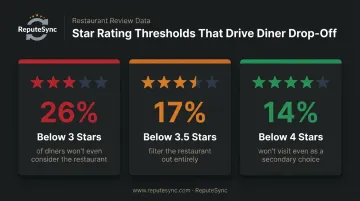
A restaurant sitting at 4.1 while a nearby competitor holds 4.6 is being filtered out of consideration by a significant share of potential diners — before they ever click through.
The Revenue Connection
A Harvard Business School study tracking Seattle restaurants found that a one-star increase in Yelp rating produced a 5–9% revenue increase for independent restaurants. That data is from 2011. Since then, online search has replaced word-of-mouth as the primary way diners discover restaurants — which means the revenue impact of ratings has only grown.
The Compounding Cycle
Reviews create momentum. More five-star reviews → higher Google ranking → more diners → more reviews. The gap between a restaurant actively managing its reputation and one leaving it to chance compounds every month.
That gap has a measurable cost. Repute Sync's platform data shows that 30% of lost customers don't return without proactive reputation management — guests who experienced a problem, or simply drifted to a competitor with stronger reviews, rarely come back on their own.
How to Get More Five-Star Reviews for Your Restaurant
Review volume isn't accidental. The restaurants at the top of local search results follow a repeatable process. These steps work together — no single one is enough on its own.
Step 1: Deliver a Review-Worthy Experience
Reviews are written in the moments that exceed expectations, not just meet them. The specific touchpoints that most influence whether a guest feels compelled to write something:
- The greeting — acknowledged quickly, warmly, without a script
- Wait time management — how delays are communicated matters more than the delay itself
- Food presentation — the first visual impression of the dish
- Error recovery — a mistake handled generously often earns a better review than a flawless meal
- The farewell — guests who leave feeling genuinely appreciated are far more likely to review
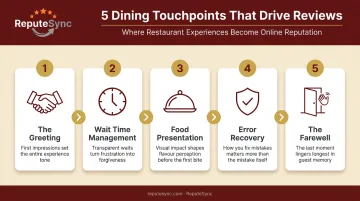
A small detail can become the entire review. A server who notices a guest mentioned it's their anniversary and brings a complimentary dessert with a handwritten note gives that diner something specific to write about. Specificity is what makes a review persuasive, and those details are created through intentional, human moments — not back-of-house processes.
Step 2: Ask at the Right Moment
Timing is the most consistently overlooked variable in review collection. Ask too early and the experience isn't complete. Ask two days later and the emotional high has faded.
The optimal window is the moment of peak satisfaction: when the check arrives and the guest is still at the table, or the instant a guest expresses unprompted verbal appreciation ("Everything was wonderful tonight").
A natural, low-pressure ask outperforms any scripted pitch:
"We'd love to hear your thoughts on Google if you have a moment — it really helps us."
That's it. No QR code waving, no lengthy explanation. The key is that it feels genuine rather than procedural.
Step 3: Make It Effortless to Leave a Review
Friction kills follow-through. Every additional step a diner has to take after leaving your restaurant reduces the likelihood they'll complete a review.
Two practical friction-reducers:
QR code on the receipt or table card — links directly to your Google Business Profile review page, not a generic homepage. One restaurant brand saw a 65% increase in feedback submissions after adding QR codes alongside post-visit email follow-up.
Same-day SMS or email — a brief, personal-feeling message sent within a few hours of the visit while the experience is still fresh. Keep it short: a single sentence expressing appreciation and a direct review link. Automated doesn't have to feel automated.
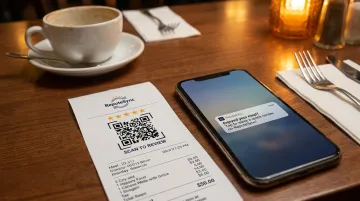
Note: Google permits review requests via direct link or QR code. Yelp's policy is more restrictive — their guidelines explicitly advise against asking customers to review your business. Direct your review requests accordingly.
Step 4: Use Automated Review Request Tools
Manual follow-up doesn't scale. A restaurant serving 300 covers on a Saturday night cannot rely on staff memory to follow up with each guest by Monday morning.
Purpose-built tools close this gap by automating timely review requests without adding to your team's workload. Repute Sync, built specifically for restaurants, automates review collection across multiple platforms from a centralized dashboard — so owners can run a consistent review strategy without managing it manually.
That consistency is the difference between restaurants that steadily accumulate reviews and those that plateau after a strong week.
Step 5: Build a Review Culture Across Your Team
Front-of-house staff are your primary review lever. A server who confidently and warmly makes the ask at the right moment will generate more five-star reviews than any automated tool alone.
What effective training looks like:
- Teach staff to recognize verbal and nonverbal satisfaction cues (big smiles, lingering at the table, unprompted compliments)
- Give them one or two natural phrases to use — not a script, just a starting point
- Make the ask part of the farewell routine, not an awkward add-on
Internal reinforcement that sustains the behavior:
- Share positive reviews at pre-shift meetings
- Call out staff members mentioned by name in reviews
- Track review volume as a visible team metric alongside other performance data
Staff mentioned by name in five-star reviews tend to repeat the behaviors that earned them. Recognition is one of the cheapest and most effective tools in a review strategy.
Factors That Affect Whether Diners Leave a Review
Even when a restaurant executes well, review rates vary. These controllable factors make a measurable difference.
Platform Familiarity
Diners leave reviews on platforms they already use. Sending a guest to an unfamiliar site adds a login barrier that kills most review attempts before they start.
Toast's consumer data shows the breakdown of where diners check restaurant ratings first:
| Platform | Diners who check here first |
|---|---|
| 46% | |
| Yelp | 23% |
| TripAdvisor | 9% |
| OpenTable | 6% |
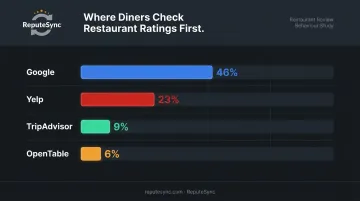
Practical implication: Google is the default priority for most restaurants. Yelp and TripAdvisor are worth maintaining, particularly for casual and fine dining. OpenTable reviews matter for reservation-driven concepts since only verified diners can submit them.
Speed of the Ask
Memory of a dining experience — and the emotional pull to write about it — fades faster than most restaurant owners assume. The satisfaction felt at the table doesn't survive two days intact.
Restaurants that send review requests the same day the visit occurs consistently collect more reviews than those that wait. The longer the gap, the lower the conversion. Automated same-day follow-up is the most reliable fix.
Existing Review Volume and Momentum
Diners who are on the fence about leaving a review take a cue from the restaurant's existing review activity. A restaurant with 400 recent reviews signals that feedback is welcomed and noticed. A restaurant with 12 reviews from two years ago signals the opposite.
Black Box Intelligence data shows restaurants average just over 9 new Google reviews per month, with top-tier full-service concepts averaging closer to 20. Building early volume creates a compounding effect: each new review makes the next one slightly more likely.
How You Respond to Existing Reviews
Potential reviewers observe how you treat the people who already wrote something. A restaurant that ignores its reviews, or responds defensively to criticism, signals that leaving a review isn't worth the effort.
66% of diners in Toast's research said they'd return after a negative experience if the restaurant responded thoughtfully. A response practice that's warm, specific, and consistent across platforms shows diners the restaurant is paying attention — and encourages future guests to do the same.
Common Mistakes Restaurants Make When Asking for Reviews
Most restaurants don't struggle with the idea of collecting reviews — they struggle with execution. These three mistakes account for the majority of lost review opportunities:
Asking regardless of how the meal went. Prompting every guest at checkout, without reading the table first, sends dissatisfied diners directly to a one-star rating. Servers who sensed friction during service should flag the table internally rather than defaulting to the review pitch.
Sending to the wrong destination. If your review request link drops a guest on your homepage instead of directly on the Google review submission screen, most will abandon it. Deep-link to the exact review page — every extra click is a conversion lost.
Collecting reviews but never responding. Ignoring reviews after they come in breaks the feedback loop that keeps new ones coming. Silence on positive reviews is a missed opportunity. Silence on negative ones is a reputational risk. Either way, an unmanaged listing is one Google treats as inactive.
How to Respond to Five-Star Reviews the Right Way
A response to a five-star review isn't just courtesy — it's a public message read by every future diner who scrolls past it. A generic "Thanks for visiting!" tells those readers nothing. A warm, specific response tells them the restaurant actually reads its reviews and cares about the people in them.
What an effective response includes:
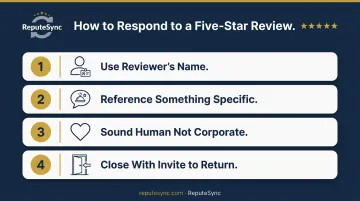
- Use the reviewer's name — it personalizes the response immediately
- Reference something specific: a dish they mentioned, a server they praised, or an occasion you helped celebrate
- Express gratitude that sounds human, not corporate — skip "We appreciate your patronage"
- Close with a brief invitation to return, nothing salesy
Aim to respond within 24–48 hours. Responses on Google, Yelp, and TripAdvisor are all publicly visible, and maintaining a consistent response practice across platforms matters. A platform like Repute Sync centralizes responses across all three so no review slips through unacknowledged.
Example response:
"Thank you so much for this, Maria — so glad the braised short rib hit the mark and that James made your anniversary dinner feel special. We'd love to have you back to celebrate the next one."
Short, specific, human. That's the goal.
Frequently Asked Questions
What does a five-star review mean for a restaurant?
A five-star review is the highest rating on platforms like Google and Yelp, confirming that a guest's experience fully delivered. For restaurants, it's the most powerful form of social proof available — more credible than advertising because it comes from a real guest with nothing to sell.
How do you write a five-star restaurant review?
Strong five-star reviews name specific dishes, describe a standout service moment, and give future diners something concrete to picture — not just "great food and atmosphere." Mentioning a staff member by name or noting how a special request was handled adds the kind of authenticity that helps readers make an actual decision.
Which review platform matters most for restaurants?
Google is the highest priority — it directly affects local search rankings and Maps visibility. Yelp, TripAdvisor, and OpenTable are secondary priorities depending on your category, with OpenTable carrying extra weight for reservation-driven concepts since its reviews come only from verified diners.
Can restaurants legally ask customers for five-star reviews?
Yes — but always ask for an honest review, not a five-star rating specifically. Incentivizing positive reviews violates Google and Yelp's terms of service, and the FTC's Consumer Reviews and Testimonials Rule (effective October 2024) explicitly prohibits conditioning any reward on positive sentiment.
How many reviews does a restaurant need to rank well on Google?
Google hasn't published a minimum threshold. What matters is consistent, ongoing accumulation — both volume and recency factor into local rankings. Industry data suggests restaurants in competitive markets average around 9 new Google reviews per month, with top-performing concepts closer to 20. Consistent velocity over time matters more than hitting a specific number.
Should restaurants respond to every five-star review?
Yes. Responses signal to Google that the listing is active and engaged, and they show future diners that the restaurant takes guest feedback seriously. Even a brief, personalized response to a five-star review carries meaningful reputational value — and each response adds a layer of public trust that no ad spend can replicate.