Introduction
It's Friday night. Your dining room is packed, the waitlist at the door has stretched to 45 minutes, and table seven — two guests who finished their pasta an hour ago — are deep into what appears to be a life recap over cold coffee. Meanwhile, three waiting parties are checking their phones with diminishing patience.
This scenario plays out in restaurants every weekend. And how you handle it determines not just tonight's revenue, but whether those waiting guests come back — and whether table seven leaves a one-star review.
This guide covers practical, respectful strategies for managing table turnover: setting expectations before guests sit down, handling the direct conversation when hints aren't working, and protecting your online reputation when things get awkward. No passive-aggressive tablecloth tricks. No hovering. Just approaches that work without burning relationships.
Key Takeaways
- Every occupied, non-ordering table during peak hours has a measurable cost in lost seat-hour revenue
- Prevention beats intervention — set timing expectations at booking, not mid-visit
- Lead with non-verbal cues — cleared table, check presentation — before making any verbal request
- A direct, calm request is always more effective than indirect pressure
- Negative reviews from difficult interactions are manageable; how you respond publicly shapes the lasting impression
Why Table Turnover Matters More Than You Think
The Seat-Hour Economics
Revenue in a full-service restaurant isn't generated by the meal — it's generated per seat, per hour. Cornell University researchers studying a Phoenix casual dining restaurant found that reducing meal duration by just one minute during high demand could raise Revenue Per Available Seat Hour (RevPASH) by 1.5% to 2.0%. A simulation reducing average dining time from 60 to 54 minutes produced a 3%–5% RevPASH increase.
Across a busy Friday night with 60 seats, those percentages translate directly to real revenue. Every minute a finished table lingers is income the next waiting party never generates.
The Ripple Effect
A single table overstaying by 45 minutes doesn't just affect that table's server. It triggers a chain reaction:
- Waiting guests grow frustrated and may leave
- Hosts lose control of their seating flow
- Servers lose tip revenue on reduced covers
- The overall dining atmosphere degrades for everyone present
The operational stress also lands on staff, who are often reluctant to escalate the situation without clear management support. That hesitation is where good systems matter.
A Note on Dining Duration Benchmarks
You may have seen the "30/30/30 rule" — 30 minutes each for ordering, eating, and dessert/check, totaling 90 minutes. No verified industry study documents this as a formal standard; treat it as an informal heuristic. What operators actually apply, per OpenTable, are reservation-linked time windows:
- 2 guests: ~90 minutes
- 4+ guests: ~120 minutes
Proactive Strategies to Prevent Table Lingering
The best table turnover conversation is one you never have to have. Most overstays happen not because guests are inconsiderate, but because no one told them a timeline existed.
Set Time Expectations at Booking
Include the dining window in your reservation confirmation: "We have the table reserved for 90 minutes for your party." Say it verbally at seating too. Cornell research found that guests who are familiar with maximum-duration policies rate them as significantly more fair and acceptable than guests who encounter them as a surprise mid-meal.
Communicating limits before service begins removes most of the friction from the rest of the evening.
Pace the Meal Deliberately
Train front-of-house staff to manage course timing proactively:
- Don't let empty plates sit for 10 minutes between courses
- Present the check naturally once the meal has clearly concluded, not 20 minutes later
- Clear finished drinks promptly — full glasses signal ongoing service; empty ones signal completion
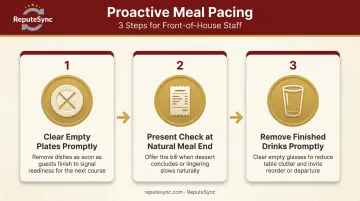
Pacing is about maintaining rhythm so the meal has a clear arc and a natural conclusion — not about moving guests along before they're ready.
Design Your Environment Intentionally
Ambient elements influence how long guests choose to stay. A 2024 field experiment found mean dining stays of 72 minutes with slow background music versus 45 minutes with faster music. A second study found no significant effect, so the evidence is mixed.
Still, it supports a principle casual dining operators already apply: brighter light, upbeat music, and less plush seating encourage guests to wind down rather than settle in.
Fine dining operators make the opposite choice deliberately, and that's legitimate. The point is to make your environment's design intentional, not accidental.
Train Staff to Read the Table
Teach servers to recognize the organic transition from dining to socializing:
- Plates pushed aside, napkins off laps
- Drinks finished and not reordered
- Conversation volume lowered, phones out
- No engagement with menu or server
These are the signals to begin the wind-down sequence — clearing the table, presenting the check — not when a timer goes off.
Polite Techniques to Signal It's Time to Go
Non-verbal cues handle the majority of overstays without any conversation required. Use them in sequence before escalating.
The Cleared Table Method
Once food and drinks are finished, clear everything: dishes, condiments, napkins, salt and pepper. This creates an unconscious social signal that the meal has ended. Jonathan Deutsch, Ph.D., writing in Restaurant Business, recommends clearing every possible item after dropping the check as a subtle but effective departure cue. It works best with socially aware guests — not a universal signal, but effective enough to be the first move.
The Check Presentation
Present the check warmly but promptly once the meal concludes. The language matters:
"Whenever you're ready — absolutely no rush!"
That phrase is honest. It signals closure without pressure. Placing the check is the cue — the words just soften the delivery.
The Manager Walk-By
A purposeful but warm presence from the manager or owner near a lingering table — making eye contact, greeting them briefly, checking that everything was excellent — adds a layer of social awareness without saying anything direct. Most guests read the signal. For guests waiting at the door, it also signals that the floor is being actively managed.
What Not to Do
A few tactics that operators sometimes use but shouldn't:
- Changing the tablecloth while guests are seated reads as openly confrontational
- Withdrawing service attention is passive-aggressive and will likely generate a complaint
- Hovering creates anxiety without resolving anything
- Sending multiple staff members past the table pressures without clarity
When subtle cues don't land, a direct and respectful conversation closes the situation faster — and with less damage to the guest relationship.
How to Directly and Respectfully Ask a Customer to Leave
When to Have the Conversation
A direct verbal request should only come after non-verbal techniques have been tried and haven't worked, and when you genuinely need the table — not as a first response to guests who've lingered 10 minutes past their meal. The threshold matters.
Choosing the Right Words
Deutsch recommends setting expectations before the meal where possible:
"We are so happy you are dining with us. Just so you are aware, we have another reservation at this table at 8:00."
If that window has passed and guests are still seated, the direct version:
"We have guests waiting and I want to make sure everyone gets a great experience tonight — would you be comfortable moving to our bar area to continue your evening?"
For a firmer situation where a previous gentle approach was ignored:
"I appreciate your patience — we do have a reservation coming in for this table now, so I'll need to ask that we wrap things up. Can I help with anything before I bring your receipt?"
Tone guidelines:
- Calm and neutral — not apologetic, not aggressive
- Brief — don't over-explain or negotiate
- Non-negotiable in content, warm in delivery
- Avoid excessive "I'm so sorry" language, which undermines the message
Handling Pushback
If a guest says they weren't told about a time limit:
- Acknowledge their frustration without debate: "I completely understand, and I apologize if that wasn't communicated clearly."
- Restate the need: "We have a reservation for this table, so I need to ask that we wrap up."
- Offer something small — a complimentary dessert to go, a note for their next visit. This preserves the relationship without encouraging repeat overruns.
If a server is struggling, the manager steps in immediately. Passing the situation between staff gives the guest leverage and creates confusion — one person owns the conversation from start to finish. Handling these moments with clarity and consistency protects the guest relationship, which matters long after the check is paid.
Handling Difficult Situations: When Guests Refuse to Leave
Most overstay situations resolve at the non-verbal or first verbal stage. But some don't.
The Escalation Path
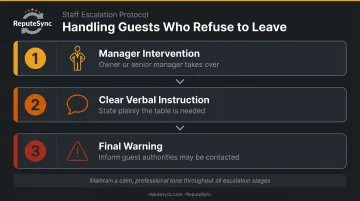
When a guest refuses a direct, reasonable request:
- Manager intervention — the owner or senior manager handles all further communication
- Clear verbal instruction — state plainly that the restaurant needs the table and the guest needs to leave
- Final warning — if refusal continues, calmly inform the guest that you may need to contact local authorities
Restaurants in the U.S. are private property and public accommodations under federal law. Owners have the legal right to ask guests to leave, provided the reason is operational — not based on protected characteristics like race, religion, national origin, or disability.
Refusal to leave after a lawful request can constitute trespassing under most state laws. Exact procedure varies by jurisdiction, so it's worth knowing your local rules before a situation escalates.
Never: engage in physical confrontation, raise your voice, or allow staff to handle an abusive guest alone.
How you handle these moments also shapes how your restaurant is perceived.
The Brand Case for Holding the Line
Seth Gerber, managing partner of MIDA, argues that firm, polite boundary-setting by restaurant leadership strengthens a brand rather than undermining it. Other guests in the room are watching. Allowing abusive behavior to continue signals to your team and other diners that the dining room has no standards. Handling it calmly and directly tells them the opposite — that this is a room worth being in.
Protecting Your Restaurant's Reputation After a Difficult Guest Interaction
The Review Risk Is Real
Guests who are asked to leave — even politely — are more likely to post a negative review. It's an emotional response to feeling embarrassed or called out. Expecting it lets you prepare for it.
According to Toast's 2024 research, 66% of diners would consider returning to a restaurant that responded to a negative review with genuine care. A poor or generic response doesn't achieve that — it can actually make the sentiment worse.
How to Respond to a Negative Review
The right response:
- Acknowledges the guest's experience without admitting fault for things that weren't your error
- Is specific, not templated
- Invites direct follow-up: "We'd love to speak with you directly — please reach out to us at [contact]"
- Is posted publicly and promptly, because other potential diners are reading it
What to avoid:
- Defending yourself extensively in the public response
- Apologizing for things that were operationally correct decisions
- Generic responses that sound automated or dismissive
Compensation alone (discounts, free meals) may help in some cases, but a specific, substantive response consistently outperforms a generic apology for actual recovery satisfaction.
Monitoring Platforms Proactively
After a difficult interaction, check your review platforms the next morning. Don't wait for a notification that may arrive late.
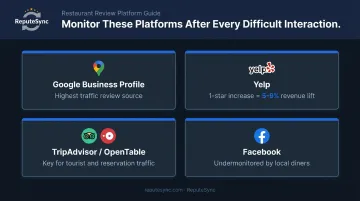
Platforms worth checking after any difficult guest interaction include:
- Google Business Profile — typically your highest-traffic review source
- Yelp — particularly important for independent restaurants; a one-star increase has been associated with a 5%–9% revenue lift
- TripAdvisor and OpenTable — especially relevant if you attract tourists or reservation-heavy traffic
- Facebook — often undermonitored but frequently used by local diners
For restaurants managing reviews across multiple platforms at once, Repute Sync centralizes monitoring and response into a single dashboard, with real-time alerts and sentiment tracking built specifically for the restaurant industry. Staying on top of your rating after a difficult incident is one of the most direct levers you have on future revenue.
Frequently Asked Questions
What is the 30/30/30 rule for restaurants?
It's an informal heuristic suggesting a typical full-service meal breaks into three 30-minute phases — ordering, eating, and dessert/check — totaling roughly 90 minutes. No formal industry study documents it, but it's a reasonable benchmark operators use to gauge when a table's visit has naturally concluded.
How do you ask a customer to leave a restaurant?
Approach the table personally, acknowledge their experience positively, and state the operational need directly: "We have guests waiting for this table." Offer a transition option if possible (bar seating, dessert to go). Keep it warm and brief. Hints and indirect pressure usually backfire.
Can a restaurant legally ask a customer to leave?
Yes. Restaurants in the U.S. are private property, giving owners the right to ask guests to leave for operational, non-discriminatory reasons. Refusal can constitute trespassing under most state laws. Federal law prohibits removal based on race, religion, national origin, or disability.
What do you say when asking customers to leave your restaurant?
Something like: "We so appreciate you spending your evening with us — we have another reservation coming in for this table, so whenever you're ready, I can help wrap things up." Warm and brief — phrasing it as a statement rather than a question signals that the conversation has a clear next step.
How do you handle a customer who refuses to leave?
Escalate to the owner or manager immediately. State clearly that continued refusal may require contacting local authorities. Avoid physical confrontation, document the interaction, and keep other guests' comfort in mind throughout.
How do you prevent bad reviews after asking a guest to leave?
Respond promptly and specifically to any negative review that follows — acknowledge their experience, invite direct follow-up, and avoid generic apologies. Use a reputation monitoring tool to catch reviews quickly, before the damage spreads across platforms.