The real problem isn't that reviews exist. It's that most restaurant owners are managing Google, Yelp, TripAdvisor, OpenTable, and Facebook simultaneously, with no centralized system. Reviews slip through. Responses come late. Unhappy customers leave and don't come back.
This guide covers what review tracking actually is, which platforms carry the most weight for restaurants, and the best tools available today — from purpose-built platforms to multi-location management suites.
Key Takeaways
- 94% of diners consult online reviews before choosing a restaurant
- Review tracking tools consolidate multiple platforms into one dashboard, preventing missed feedback
- Google dominates with over 95% of restaurant review volume — it's the non-negotiable starting point
- The best tools handle monitoring, response management, and review generation in one place
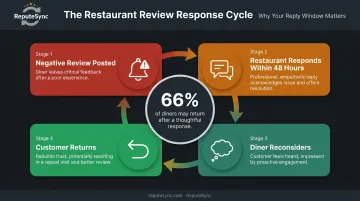
- 66% of diners say they'd reconsider a restaurant that responds to their negative review — making response management a direct revenue lever
Why Review Tracking Is Essential for Restaurants
Restaurants generate feedback at a pace most other businesses don't. A busy Saturday night can produce dozens of reviews before Sunday brunch. That volume creates a real operational problem: without a system, reviews pile up unread, and negative ones go unanswered.
The Cost of Ignoring Reviews
The business stakes are concrete. Black Box Intelligence reports that Google captures over 95% of all online restaurant reviews, with the average restaurant accumulating more than 220 cumulative reviews. Top full-service concepts collect close to 20 new reviews per month. At that velocity, manual monitoring across five platforms isn't realistic.
Repute Sync's platform is built around one particularly sobering insight: 30% of lost customers don't return without proactive reputation management. Left unaddressed, that's a permanent revenue gap, not just a one-time service miss.
The good news from Toast's data is actionable: 66% of diners say they'd consider returning after a negative review if the restaurant responds and shows it cares. That's a recoverable situation. But only if someone sees the review and responds in time.
Review Tracking and Local Search
Customer recovery is only part of the picture. Review management also shapes how your restaurant ranks in local search. Google states that more reviews and positive ratings can help a business stand out in local results, and that responding to reviews signals that feedback is valued.
Restaurants that actively manage their reviews build compounding visibility over time. Every response, every new rating, and every resolved complaint contributes to stronger local search presence.
Review Platforms Every Restaurant Should Be Monitoring
Not all review platforms carry equal weight. Where you invest your attention should match where your customers actually spend theirs.
Primary Platforms
| Platform | Why It Matters |
|---|---|
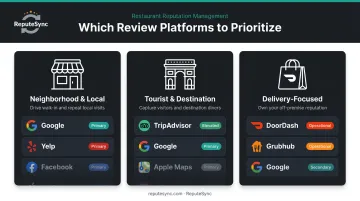
| Google Business Profile | 46% of diners check Google first; captures 95%+ of restaurant review volume |
| Yelp | 23% check Yelp first; especially influential for walk-in decisions in urban markets |
| TripAdvisor | 9% check TripAdvisor first; critical for tourist-area and destination restaurants |
Secondary Platforms Worth Watching
- OpenTable and Resy — verified post-reservation reviews carry high credibility; OpenTable has seated 1.9 billion diners annually across 65,000+ restaurants
- Facebook — community trust matters, particularly for older demographics (70% of diners aged 45–54 use Facebook for restaurant discovery)
- DoorDash and Grubhub — delivery-specific feedback on packaging, accuracy, and speed; DoorDash data shows that responding to reviews increases reorder rates by 17%
How to Prioritize
- Neighborhood and local spots get the most mileage from Google and Yelp
- Tourist-area and destination restaurants should weight TripAdvisor more heavily in their monitoring mix
- Delivery-dependent operations need to treat DoorDash and Grubhub reviews as operational feedback, not just reputation data
Best Review Tracking Tools for Restaurants
These tools were selected based on restaurant-industry relevance, platform coverage, ease of use, and suitability for both single-location and multi-location operators.
Repute Sync
Repute Sync is a reputation management platform built exclusively for the restaurant industry, headquartered in Raleigh, NC. Its workflows and metrics were built specifically for dining businesses — not adapted from generic software. The platform combines automated review collection, multi-platform monitoring, and performance tracking in one end-to-end workflow.
| Feature | Details |
|---|---|
| Key Features | Multi-platform review monitoring and response from a single dashboard; automated review collection; data-driven performance tracking; restaurant-specific reputation workflows |
| Pricing | Contact Repute Sync for current pricing; demo available at reputesync.com |
| Best For | Independent restaurants, local dining establishments, and multi-location restaurant groups seeking a purpose-built reputation management solution |
GatherUp
GatherUp (formerly GetFiveStars) focuses on proactively generating reviews through automated email and SMS campaigns while also monitoring existing reviews across Google, Facebook, and 100+ additional platforms. It includes NPS score tracking and a website review widget that helps convert uncertain visitors into paying guests.
For independent and local restaurants, the review request automation is valuable — it turns satisfied diners into active reviewers rather than waiting passively for feedback to arrive.
| Feature | Details |
|---|---|
| Key Features | Automated review request campaigns via email and SMS; NPS tracking; 100+ platform monitoring; website review widgets; white-label agency options |
| Pricing | Single location starting at $99/month; multi-location at $60/month per location; 20% savings with annual billing |
| Best For | Local and independent restaurants looking to grow review volume while monitoring their existing reputation |
Reviewly AI
Reviewly AI focuses on Google review management with an automation-first approach. It collects reviews through SMS (across 100+ countries), QR codes, NFC tags, and physical Review Plates — with AI-driven sentiment detection and response drafting managed from a central dashboard.
The SMS-first collection method is particularly practical for high-turnover restaurant environments where staff have seconds, not minutes, to interact with departing guests.
| Feature | Details |
|---|---|
| Key Features | SMS, QR, and NFC review collection; AI sentiment detection and response drafting; centralized dashboard; physical Review Plate collection tool |
| Pricing | Single Location: $99/month (or $999/year); Premium Location: $139/month; Enterprise: custom pricing |
| Best For | Multi-location restaurants and hospitality businesses seeking automated Google review generation at scale |
ReviewPush
ReviewPush is a cloud-based review monitoring tool with solid adoption in food service. It aggregates reviews from Google, Yelp, and other platforms into a single dashboard, with email alerts and reporting organized by location, region, or district.
Its straightforward setup and accessible starting price make it a practical fit for smaller restaurant groups that want multi-platform visibility without enterprise-level complexity.
| Feature | Details |
|---|---|
| Key Features | Multi-site review monitoring with email alerts; location/region/district reporting; review response via email; Buffer integration |
| Pricing | Lite plan starting at $49/location/month; Plus at $99; Max at $199 |
| Best For | Small to midsize restaurant groups wanting straightforward multi-platform monitoring without enterprise overhead |
How to Choose the Right Tool for Your Restaurant
Selection should be based on more than price. Here's what actually matters:
- Restaurant-platform coverage — Does the tool monitor the sites your diners actually use? Generic tools often miss OpenTable and TripAdvisor entirely
- Response workflow — Can you respond to reviews from within the platform, or does it only alert you and send you elsewhere?
- Review generation vs. monitoring — Monitoring tracks what's already been said. The strongest tools also prompt satisfied customers to leave new reviews, keeping your rating climbing instead of just holding steady
- Single vs. multi-location needs — A single-location independent restaurant needs different functionality than a 20-location chain
Knowing what to look for also means knowing what to avoid. The most common mistakes restaurants make during selection:
- Choosing a generic tool that doesn't cover restaurant-specific platforms
- Prioritizing price over response capability — a monitoring tool that can't help you respond leaves you watching problems instead of fixing them
- Focusing only on monitoring and ignoring review generation, which keeps you permanently reactive
Conclusion
Online reviews aren't a passive byproduct of service. They actively determine which restaurants show up in search, which ones get the reservation, and which ones a diner recommends to a friend. The right tracking system is what lets restaurants actively manage that dynamic instead of reacting to damage after it's already done.
Assess your situation honestly. A single-location independent restaurant likely needs a tool focused on review generation and monitoring. A growing chain needs multi-location dashboards with location-level reporting and response workflow management built in.
For restaurant owners who want a platform built specifically for the industry — not adapted from a generic tool — Repute Sync offers a dedicated workflow covering review monitoring, response management, and customer recovery — all in one place. Book a demo at reputesync.com to see how it fits your operation.
Frequently Asked Questions
What is a review tracker?
A review tracker is software that monitors and aggregates customer reviews from multiple platforms — such as Google, Yelp, and TripAdvisor — into a single dashboard. It alerts you when new reviews appear and provides response tools, eliminating the need to check each site manually.
How do I track a Google review?
You can track Google reviews directly through your Google Business Profile by monitoring the Reviews tab in your account. Alternatively, a dedicated review tracking tool will automatically monitor your Google listing and alert you whenever a new review is posted.
Which review sites matter most for restaurants?
Google is the highest priority — it drives local search rankings and captures over 95% of restaurant review volume. Yelp and TripAdvisor heavily influence dining decisions, while OpenTable and Resy matter specifically for verified post-reservation feedback.
How often should restaurants respond to online reviews?
Respond to all reviews within 24 to 48 hours — negative ones especially. Timely responses signal to Google that your business is active, and studies show 66% of dissatisfied guests would consider returning after a thoughtful reply.
Can review tracking tools help improve a restaurant's star rating?
The tools themselves don't generate better reviews, but they help identify service issues faster, enable timely responses to unhappy diners, and automate review requests to satisfied guests. Restaurants that act on those signals typically see ratings climb steadily over 60 to 90 days.