The stakes are real. A 2024 Dynata survey of 1,000 US consumers found that negative food-quality reviews make 63% of diners less likely to visit a restaurant — and negative cleanliness reviews deter 62%. Every unanswered complaint sitting publicly on Google or Yelp is working against you.
But responding effectively isn't just about damage control. Timing, tone, platform context, and follow-through all shape whether your reply helps or hurts. This guide walks through the exact steps to craft a strong response, what to set up beforehand, and how to handle the situations where a standard reply won't cut it.
Key Takeaways
- Respond to negative reviews within 24–48 hours — silence reads as indifference
- Follow a clear response sequence: acknowledge the issue, take ownership, and move the conversation offline
- Personalize every response — generic replies are easy to spot and signal inauthenticity
- Treat recurring complaints as an operational signal, not just a PR problem
- Build a response system before the next bad review lands — not after
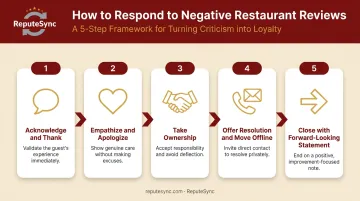
How to Respond to Bad Feedback: A Five-Step Framework
Step 1: Acknowledge the Reviewer and Thank Them
Start with the reviewer's name if it's visible, and open with a genuine thank-you. Something like:
"Hi [Name], thank you for taking the time to share your experience with us."
This isn't agreement — it signals that your restaurant listens. A non-confrontational opener sets the tone and reduces the chance the exchange escalates publicly.
Step 2: Empathize and Apologize
Validate the customer's experience before anything else. Even if the complaint feels exaggerated, leading with empathy defuses tension faster than any explanation will.
"We're sorry your visit didn't meet the experience we aim to deliver."
Apologizing for someone's experience is always appropriate. Admitting specific fault is a different matter — that depends on confirmed facts. Don't confess to operational failures you haven't verified — but don't wait for certainty before showing empathy, either.
Step 3: Take Ownership Where Warranted
If something clearly went wrong — a long wait, an incorrect order, a staff interaction that fell short — acknowledge it briefly and without deflection.
What to avoid:
- Over-explaining what happened internally
- Blaming specific staff members publicly
- Making excuses that shift responsibility to circumstances
Even when the issue is a misunderstanding, "we can see how that created frustration" lands better than disputing the customer's account. The public audience watching this exchange responds to accountability, not defenses.
Step 4: Offer a Resolution and Move It Offline
A public response should always include a clear next step. Invite the reviewer to contact a manager directly — include an email address or phone number — and keep the resolution conversation private.
This serves two purposes:
- It gives the unhappy guest a real path to resolution
- It shows every potential diner reading the review that you take complaints seriously and act on them
That second point is often more valuable than the first. Future diners reading the exchange are your real audience — a well-handled response can reassure them more effectively than the complaint itself can deter them.
Step 5: Close with a Forward-Looking Statement
End with something specific, not generic. A brief mention of how the feedback will improve your operation, or a sincere invitation to return:
"We hope to have the opportunity to welcome you back and show you what we're really about."
When a complaint points to a systemic issue you're actively fixing, referencing the corrective action is more credible than a blanket invitation. A response that names the actual change you're making — shorter ticket times, retraining on a specific process — gives readers something concrete to evaluate rather than a promise to take on faith.
What to Set Up Before You Respond to Any Review
Reactive response without a system produces inconsistent tone, missed reviews, and slow replies. Before the next complaint lands, three things should already be in place:
- Clear ownership — who on your team is responsible for reviewing and responding, and who approves replies for sensitive situations
- Tone guidelines — a brief written guide capturing your restaurant's voice, what language to avoid, and how to handle common complaint types
- A target response window — commit to a timeframe and make it part of your operations rhythm
Manually checking Google, Yelp, TripAdvisor, and other platforms daily is impractical — especially for operators running more than one location. Repute Sync centralizes reviews from multiple platforms into a single dashboard and sends alerts when new reviews are posted, so your team responds faster and nothing slips through.
When a review comes in, pull whatever internal context is available first: reservation notes, order records, staff recollections from that shift. A reply that contradicts what actually happened — even unintentionally — damages credibility more than the original review.
Key Variables That Shape the Quality of Your Response
Timing
The longer a negative review goes unanswered, the more it signals indifference. BrightLocal's 2024 survey of 1,141 US consumers found that 34% expect a response within 2–3 days of posting a review. Aim for 24–48 hours as your operating target.
Repute Sync's data shows that 30% of lost customers do not return without proactive reputation management — which means timely response isn't just good etiquette, it's a direct customer retention lever. How quickly you respond sets the floor. What you say determines whether that response actually works.
Tone
Your response should reflect your brand's personality while staying empathetic and professional. A fine dining restaurant and a neighborhood taco spot will write differently — and should. What neither can afford:
- Defensiveness or sarcasm
- The robotic coldness of a copy-paste form letter
- Minimizing the guest's experience
Tone done right varies by brand. The platform you're writing for adds another layer of constraint.
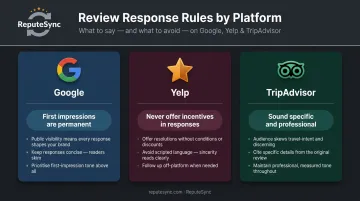
Platform Norms
Each platform has its own audience expectations and rules:
- Google — Responses appear publicly beneath reviews. Keep them concise; this is often the first thing a potential diner reads about your restaurant
- Yelp — Strictly prohibits offering incentives in exchange for reviews; keep resolution offers unconditional and off-platform
- TripAdvisor — Audiences skew travel-oriented; responses here should be specific, professional, and human in tone (TripAdvisor's own guidance emphasizes this explicitly)
Common Mistakes Restaurants Make When Responding
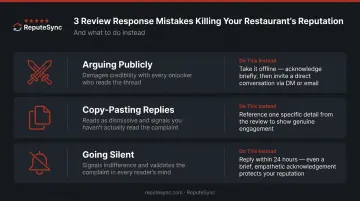
Three patterns show up repeatedly — and each one makes a bad situation worse:
Arguing publicly. Even when you're right, disputing a customer's account in a reply signals poor temperament to every reader watching. The original review rarely does as much damage as a defensive response.
Copy-pasting the same reply. Identical responses across multiple reviews — "Thank you for your feedback, we're sorry to hear this" — are easy to spot and read as dismissive. Templates are a useful starting point, but each reply needs at least one specific detail pulled from the actual review.
Going silent. An unanswered negative review reads as indifference — or worse, confirmation that the complaint is valid. The 2018 Restaurant Dive report found that more than 80% of diners favor restaurants that respond to online reviews, which puts a real cost on staying quiet.
How to Handle Specific Difficult Review Situations
Fake or Clearly Malicious Reviews
Don't lead with a public response. First, report the review to the platform for violating terms of service — Google, Yelp, and TripAdvisor all have formal reporting workflows. If you do respond publicly, keep it brief:
"We couldn't locate a matching customer record for this visit. We'd welcome the chance to look into this — please contact us directly at [email/phone] with your order details."
Don't accuse the reviewer of lying publicly, even if you're certain. It escalates the situation and reads as defensive to onlookers.
Reviews Criticizing Something Subjective
Taste, ambiance, portion size, music volume — these can't be argued away. Acknowledge the preference without suggesting the guest is wrong:
"Our chef crafts the seasoning to complement the dish's full profile, but we understand this may not suit every palate."
These responses also offer an opportunity to gently reframe for readers — noting what the majority of guests enjoy — without dismissing the individual reviewer.
Profanity-Filled or Abusive Reviews
Flag these for removal first. If the underlying complaint is legitimate beneath the hostile language, address the core issue professionally. Don't reference the abusive tone in your public reply — it draws more attention to it.
Reviews That Reflect a Systemic Problem
When multiple reviews point to the same issue — slow service, understaffing, inconsistent food quality on certain shifts — the response strategy has to change. Stop treating each complaint as a one-off.
Instead, your response approach should:
- Acknowledge the pattern honestly rather than deflecting
- Note that internal steps are being taken to address it
- Avoid repeating the same promise across five reviews without visible follow-through
These recurring complaint clusters are also the most operationally valuable feedback you'll get.
Black Box Intelligence's restaurant research found that restaurant units with the fewest complaints ran 2.2% better traffic than their peers in 2025 — outperforming even units with the most compliments. Recurring complaints deserve internal escalation as a priority fix, not just a public reply.
Frequently Asked Questions
How do I thank someone for negative feedback?
Use language that acknowledges their effort, not just their dissatisfaction — "We appreciate you bringing this to our attention" works well. Keep it genuine — a sincere thank-you signals that feedback is welcomed, not something to be defended against.
How do I respond to negative feedback without being defensive?
Lead with empathy before any explanation. Avoid the word "but" immediately after an apology — it cancels the apology. Resist correcting the customer's account even when you believe they're mistaken; acknowledge the experience first.
How do I respond to a negative review?
Follow the five-step framework: acknowledge the reviewer, empathize and apologize, take ownership where warranted, offer a resolution and move it offline, then end by inviting them back.
How do I acknowledge negative feedback from a customer politely?
Start with their name, a genuine thank-you, and a calm recognition of their frustration. Avoid minimizing language like "actually" or "normally" — phrases that signal you're about to dispute their experience rather than address it.
Should I respond to every negative review my restaurant receives?
Most negative reviews warrant a response, especially on high-visibility platforms like Google and Yelp. The exceptions are clearly fake or spam reviews — report those rather than engaging publicly.
How quickly should I respond to a bad restaurant review?
Aim for within 24–48 hours. Beyond that, the absence of a response signals indifference to both the original reviewer and every potential diner who reads the review afterward.