That gap is where most restaurants lose. They serve great food, deliver solid service, and then do nothing to capture the moment. Meanwhile, competitors with average food and aggressive feedback systems stack up five-star reviews and dominate local search results.
Asking for feedback sounds straightforward. In practice, most restaurants either skip it entirely, ask at the wrong moment, or send generic messages that diners delete without reading. This guide walks through the full process: a step-by-step approach for asking effectively, the best channels to use, and the variables that separate restaurants with 200 reviews from those stuck at 12.
Key Takeaways
- Directly asking for feedback dramatically increases response rates — 52% of diners say they'd leave a review if asked
- The best moment to ask is right after a positive interaction or within 1–2 hours of the visit
- Top-performing channels: in-person requests, QR codes on receipts, and SMS follow-ups
- Keep feedback requests short — one to three questions, one clear link
- Responding matters: 66% of diners would return after a bad experience if the restaurant responds thoughtfully
How to Ask for Customer Feedback: A Step-by-Step Process
Step 1: Define What You're Actually Trying to Learn
Before asking a single guest for feedback, decide what you need from it. That goal determines the format, the channel, and the question you ask.
Ask yourself:
- Are you trying to identify operational gaps (slow service, inconsistent food quality)?
- Do you want to generate more Google reviews to improve local search visibility?
- Are you measuring overall guest satisfaction across a specific period?
Each goal calls for a different approach. Operational feedback benefits from open-ended questions where guests can describe specific issues. Public review generation requires directing diners to a specific platform — Google, not a private form. Satisfaction tracking works best with a simple rating plus one follow-up question.
Structured vs. open-ended feedback:
- Structured (star ratings, multiple choice): Easier to collect at volume, faster for guests, simpler to analyze
- Open-ended (comment fields, verbal conversation): Richer and more specific, but harder to gather consistently
For most independent restaurants, a hybrid approach works best — a 1–3 question form with a rating and one open field.
Step 2: Identify the Right Moment to Ask
Timing determines whether a diner responds at all. Ask too early and it feels intrusive; wait three days and the emotional connection to the meal is gone.
The best moments during the visit:
- After entrées are cleared and the table feels relaxed
- When presenting the check, while the diner is still engaged
- During a natural end-of-meal conversation, especially if a guest has complimented the food or service
For post-visit digital requests, send within 1–2 hours of departure. The meal is still fresh, the positive feeling hasn't faded, and the diner hasn't mentally moved on to the rest of their day. Waiting until the next morning — let alone the next week — produces noticeably lower response rates and less detailed feedback.
Step 3: Craft a Request That Feels Human
A message that reads like a marketing template gets treated like one. Train servers to make the verbal ask specific and genuine:
"Was there anything tonight we could have done differently?" — far more effective than "How was everything?"
The generic question invites a reflexive "Fine." The specific one signals that you actually want to know.
For digital requests, follow these rules:
- Use the guest's name when you have it
- Reference the visit specifically ("We hope you enjoyed dinner with us tonight")
- Keep the message to two sentences and one link
- Never send a form with more than three questions — Typeform data shows surveys with more than six questions have completion rates below 50%, and restaurant guests have even less patience than the average survey respondent
Step 4: Remove Every Barrier to Responding
Every extra click, field, or redirect is a dropout point. The simpler the path, the higher the completion rate.
The lowest-friction feedback options:
- A QR code on the receipt that opens directly to your Google review page
- An SMS with one sentence and a direct link — no login required
- A tablet near the exit set to a simple star-rating screen (capture email here, send the actual review link later)
- A host asking a single verbal question as guests walk out
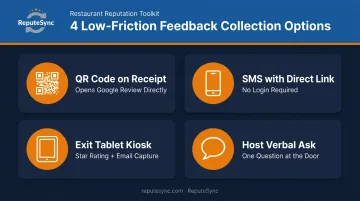
When the path from satisfied guest to posted review takes under 30 seconds, completion rates follow.
The Best Channels for Collecting Restaurant Customer Feedback
No single channel works for every restaurant or every diner. A fast-casual lunch spot has different dynamics than a fine-dining tasting menu. Match the channel to how your guests naturally behave.
In-Person Verbal Requests
Servers and hosts are your most direct feedback channel, and the most underused one at that. The key is training staff to ask one specific question, not the reflexive "How was everything?"
A better alternative: "Was there anything tonight we could have done differently?" or "We'd love to know what you thought of the new pasta dish."
This approach does something no digital channel can: it creates a real-time opportunity to resolve dissatisfaction before it becomes a one-star review. A guest who voices a complaint in person rarely feels the need to post it publicly.
QR Codes on Receipts and Table Materials
QR codes printed on receipts, check presenters, or table cards offer a frictionless bridge from the dining experience to a public review. They work because they catch the diner while still seated and in a positive frame of mind.
A few design rules that matter:
- Pair the code with a single clear line of instruction: "Tell us what you thought — scan to leave a quick review"
- Link directly to your Google review page, not a general website
- Test the code on multiple devices before printing
Post-Visit SMS and Email Follow-Ups
SMS is the higher-performing channel for post-visit outreach. Twilio benchmarks SMS open rates at 98% — compared to email open rates in the 31–36% range across industries. For a message that needs to be seen and acted on quickly, the gap is significant.
To use this channel, you need guest contact information — collected at reservation (via OpenTable, Resy, or similar) or through a loyalty program at checkout.
Keep the message short: one or two sentences, a direct link, no preamble. Something like:
"Hi Sarah — thanks for dining with us tonight. We'd love to hear what you thought: [link]"
Reputation management platforms like Repute Sync can automate this outreach, sending personalized review requests across multiple platforms from a single dashboard. That way, no guest slips through after a busy Saturday night and no one on your team has to remember to follow up manually.
Google and Review Platform Direct Links
Once you decide which channel to use for outreach, the next question is where to send guests. The answer for most restaurants: Google first.
**46% of diners check Google Reviews** when researching where to eat — compared to 23% for Yelp and 8% for TripAdvisor — according to a 2024 survey of 1,157 U.S. diners. Google also confirms that review count and score factor into local search rankings.
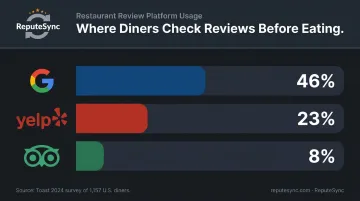
That makes Google the priority platform for most restaurants. Create a Google review shortlink through your Google Business Profile and use it everywhere: SMS messages, QR codes, email signatures. That one friction point — having to search for your business — is what stops most guests from following through.
Important platform distinctions:
- Google: Actively welcomes review requests — use it as your primary ask
- Yelp: Explicitly prohibits soliciting reviews ("Don't ask anyone to review your business") — doing so risks having reviews removed or your listing penalized
- TripAdvisor: Permits direct requests and encourages owners to engage with reviewers
On-Site Digital Kiosks or Tablets
For higher-volume restaurants, a tablet near the exit in kiosk mode lets guests leave a quick star rating before they leave. One critical rule: do not ask guests to log into personal accounts on your device. Instead, capture a rating and an email address, then send the actual review link to their phone. Cleaner experience, higher completion.
Key Variables That Affect Feedback Quality
Two restaurants can use the exact same feedback method and get dramatically different results. The difference usually comes down to one of these four variables.
| Variable | What Goes Wrong | What Works |
|---|---|---|
| Timing | Asking mid-meal or 48+ hours later | Post-entrée in person; within 1–2 hours digitally |
| Personalization | "Dear Valued Customer" templates | Guest name, visit reference, specific context |
| Channel fit | Paper comment cards for app-booking millennials | Match the channel to how your guests communicate |
| Request length | 10-question satisfaction surveys | 1–3 questions max; rating + one open field |
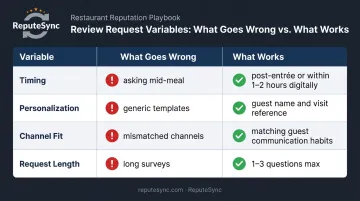
Generic requests attract generic responses. When a diner feels like their specific experience is being asked about — not their data being collected — the feedback they give is more detailed and actually usable. Keep forms short: every extra question is a reason to abandon the survey entirely.
Common Mistakes Restaurants Make When Asking for Feedback
Most of these mistakes share a common thread: treating feedback as a formality rather than a genuine tool for improvement. Here's where restaurants consistently go wrong:
- Asking too late or too many times. A request three days after a visit signals disorganization. Multiple follow-ups signal desperation. Set one well-timed request per visit and stop there.
- Using copy-paste messaging. Any message starting with "Dear Valued Customer" is immediately read as automated. Even small personalization — the guest's name, the date, a note about their reservation — makes the request feel like a conversation, not a campaign.
- Only approaching happy-looking guests. Training staff to ask only satisfied guests for feedback creates a skewed review profile and misses exactly the input that would help you improve. Offer feedback opportunities consistently, to every table, every shift.
- Ignoring feedback after collecting it. This is the most damaging mistake in restaurant reputation management. When you collect reviews and never respond, every potential diner who reads those reviews sees a restaurant that doesn't care what guests think.
What to Do After You Collect Feedback
Respond to Every Review — Promptly
According to Toast's survey data, 66% of diners would consider returning after leaving a negative review if the restaurant responds and shows it cares. Industry research also suggests that the majority of diners read management responses before deciding where to eat.
For positive reviews: a brief, specific thank-you reinforces loyalty and signals attentiveness to potential guests reading along.
For negative reviews: stay calm, acknowledge the specific issue, avoid defensive language, and offer a clear path to resolution — contact information or an invitation to return. Responding publicly to criticism is one of the highest-leverage reputation moves a restaurant can make.
Turn Patterns Into Operational Changes
Feedback is only useful if it leads to something. Categorize recurring themes:
- Repeated mentions of slow service on Friday evenings → staffing or workflow review
- Consistent praise for a specific dish → highlight it more prominently
- Multiple complaints about noise → acoustic or seating adjustment
When you make a change based on guest input, close the loop. Mention it in a social post or a follow-up message: "Based on your feedback, we've added a quieter section in the back — come try it." That kind of transparency turns one-time guests into regulars.
Monitor All Platforms from One Place
Manually checking Google, Yelp, TripAdvisor, and other platforms every day is easy to neglect, especially during a busy season. Repute Sync gives restaurant owners a single dashboard to monitor, manage, and respond to reviews across multiple platforms — so no feedback slips through. For multi-location operators, that centralized visibility means reputation issues get caught and addressed before they compound.
Frequently Asked Questions
What is the best time to ask restaurant customers for feedback?
For in-person asks, the optimal moment is right after the entrée is cleared or when presenting the check — the guest is still engaged and the meal is fresh. For digital follow-ups via SMS or email, send within 1–2 hours of departure, while the emotional connection to the experience is still present.
Should I ask for feedback verbally or use a digital channel?
Both work best together. A verbal ask from your server captures in-the-moment reactions and can head off a negative review before it's posted. A digital follow-up via SMS or email captures more considered feedback and makes it easy for guests to leave a public review at their convenience.
How can I get more diners to leave Google reviews?
Send a direct Google review shortlink via SMS or print it as a QR code on your receipt. Removing the step where a diner has to search for your restaurant manually is the biggest single driver of review volume — every extra tap is a diner you lose.
Can I offer a discount or incentive to get customers to leave a review?
No. Incentivizing reviews violates Google and Yelp's policies and the FTC's Consumer Reviews and Testimonials Rule (effective October 2024). Incentivized reviews can be removed, and the practice can damage your reputation if it surfaces. Focus on making the ask easy and the experience worth reviewing.
How should I respond to negative feedback about my restaurant?
Acknowledge the specific issue promptly, apologize without defensiveness, and offer a clear path to resolution — an invitation to return or a direct contact. Responding publicly to criticism demonstrates accountability to every potential diner who reads the review afterward.
What questions should I include in a restaurant customer feedback survey?
Keep it to 1–3 questions: an overall rating, one open question ("What could we have done better tonight?"), and optionally a likelihood-to-return or recommend question. Shorter surveys get far more completions — and more completions means more usable data.