Introduction
Picture this: it's Monday morning, you've just survived a packed weekend service, and you open your phone to find eight new reviews — three glowing, two mixed, and three that sting. One guest says the pasta was cold. Another says a server was rude. You're not sure if these are isolated incidents or patterns, and you don't know where to start.
Most restaurant owners face this exact situation. Customer feedback is the clearest window into what guests actually experience — not what you assume they experience. That gap is often where restaurants lose business, one unanswered review at a time.
The stakes are real. According to BrightLocal's 2026 Local Consumer Review Survey, 97% of consumers read online reviews for local businesses. Diners are making decisions before they ever step through your door.
This guide walks through what customer feedback actually is, how to collect and respond to it, and how to use it to build a stronger reputation over time.
Key Takeaways
- Most diners check reviews before visiting — your online reputation is your first impression
- Feedback comes in many forms: reviews, verbal comments, surveys, and social media tags
- Responding to reviews (positive and negative) directly influences whether potential guests choose you
- Turning feedback into operational changes is what separates good restaurants from great ones
- Consistent feedback habits strengthen your local search rankings over time
What Is Customer Feedback for Restaurants?
Customer feedback is any information guests share about their dining experience — food quality, service speed, ambiance, pricing, cleanliness, or how your staff made them feel. It can be solicited or unsolicited, written or verbal, detailed or just a star rating with no text.
Solicited vs. Unsolicited Feedback
Each type serves a different purpose — and you need both:
- Solicited feedback is what you actively ask for — a post-visit survey, a QR code at the table, or a follow-up email after a reservation. You control the timing and the questions.
- Unsolicited feedback happens organically on Google, Yelp, TripAdvisor, or Instagram — without any prompt from you. These carry extra weight because guests chose to share their experience publicly without being nudged.
Solicited feedback gives you structured, specific data. Unsolicited feedback reveals what guests care about enough to say without being asked — often the most honest signal you'll get.
What Counts as Feedback
Beyond those two categories, restaurant feedback is broader than most owners track. Every one of these signals tells you something real:
- A five-star Google rating with no comment
- A guest telling your server the steak was overcooked
- An Instagram Story tagging your restaurant with a photo of half-eaten food
- A 3/5 rating on a post-visit SMS survey
- A TripAdvisor review mentioning your parking situation
Each signal, large or small, reflects a real guest experience. Tracking only written reviews means missing the quieter signals that often point to your most fixable problems.
Why Customer Feedback Matters for Restaurant Success
Reviews Influence Guests Before They Arrive
Most diners decide where to eat before they ever see your menu in person. BrightLocal's 2026 survey found that 97% of consumers read reviews for local businesses, with 41% saying they "always" read reviews when browsing. That same report found 42% of consumers trust online reviews as much as personal recommendations from friends and family.
Your review profile isn't just reputation — it's a sales tool.
Feedback Exposes Blind Spots
When you're running a restaurant every day, things become invisible. You stop noticing the awkward table by the kitchen door, the menu item description that confuses first-timers, or the fact that the lunch rush backs up orders by 15 minutes. Your guests notice all of it — immediately.
Feedback gives you an outsider's perspective at scale. One complaint about slow service is anecdote. Ten complaints about slow service on Saturdays is a staffing issue.
The Cost of Ignoring It
Unhappy guests rarely confront you directly. They leave quietly, skip the return visit, and share the experience with others. According to Repute Sync, **30% of lost customers do not return without proactive reputation management** — meaning that without a deliberate effort to recover those relationships, that revenue is simply gone.
Silence doesn't recover lost customers — action does.
Responding Builds Loyalty
BrightLocal's data shows that 80% of consumers are more likely to use a business that responds to all its reviews. Equally telling: 50% are unlikely to choose a business that sends generic, templated replies.
Guests want to feel heard. When you acknowledge their feedback — good or bad — you signal that their experience matters. Consistent, personal responses are one of the lowest-cost loyalty tools available to a restaurant owner.
Feedback Drives Operational Decisions
Review patterns aren't just reputation data — they're operational intelligence. When the same issues appear repeatedly across reviews, that's a signal — not a coincidence. Common targets worth tracking include:
- Menu items that disappoint versus descriptions
- Greeting and wait times during specific shifts
- Pricing clarity and value perception
- Service gaps tied to specific staff or hours
Each of these is something you can change. Review data tells you where to start.
Types of Customer Feedback Restaurants Receive
Understanding where feedback comes from helps you build a system to capture and act on all of it.
| Feedback Type | Where It Happens | Key Characteristic |
|---|---|---|
| Online reviews | Google, Yelp, TripAdvisor, OpenTable | Most publicly visible; affects discoverability |
| In-person verbal | Servers, managers, host stand | Immediate; enables same-shift correction |
| Post-visit surveys | Email, SMS, QR code | Structured; most actionable data |
| Social media mentions | Instagram, TikTok, Facebook | Can go wide fast — positive or negative |
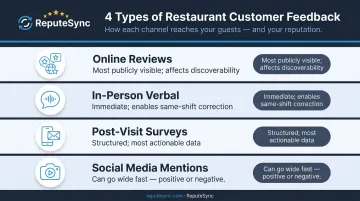
Online reviews carry the most weight for new diners. Even a star rating with no written text still pulls your average score up or down. Google is the dominant platform for local business reviews — a recent BrightLocal survey found that 71% of consumers used Google to find and evaluate local businesses.
In-person verbal feedback is the most underused channel. If your servers aren't trained to relay what guests say during the meal, that real-time signal disappears. A guest who mentions their soup is cold to a server — and has it fixed before they leave — is far less likely to write a negative review later.
Social media operates at a different scale than any other channel. A TikTok video of your dining room — good or bad — can reach thousands of people who've never heard of your restaurant. Monitoring tags and mentions is no longer optional.
How to Collect Customer Feedback at Your Restaurant
Solicited Feedback Methods
QR code surveys at the table or on receipts are the lowest-friction option available. A guest can complete a short survey while finishing their coffee. Keep it tight:
- 3–5 questions maximum
- Ask about food quality, service, and overall experience
- Make it fully mobile-friendly
- Avoid open-ended questions as your first ask — ratings first, comments optional
Post-visit email or SMS follow-ups work well when you collect contact info through reservation systems or loyalty programs. Timing matters — the sooner after the visit, the better. OpenTable recommends sending restaurant guest surveys within 24 to 48 hours, while the experience is still clear in the guest's mind. Automated follow-ups through your reservation or CRM system remove the manual effort entirely.
Comment cards and manager check-ins still work, especially with guests who prefer them. More important than the format is the quality of the check-in. Train servers to ask specific questions mid-meal — "How's the duck coming along?" lands better than "Is everything okay?" because it invites a real answer.
Unsolicited Feedback Monitoring
You can't respond to feedback you don't see. Set up Google Alerts for your restaurant's name and check your major review platforms on a consistent schedule. For owners managing multiple platforms at once, that manual process adds up fast. Repute Sync centralizes review monitoring across Google, Yelp, and other platforms into a single dashboard — no separate logins, no missed alerts. Automated review collection means problems surface before they compound into a rating drop.
How to Respond to and Act on Restaurant Customer Feedback
Responding to Negative Reviews
Every public response to a negative review is read by potential guests who haven't visited yet — and they're judging your professionalism as much as the original complaint. How you respond matters as much as the complaint itself.
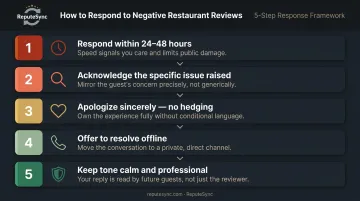
The right approach:
- Respond within 24–48 hours
- Acknowledge the specific issue raised
- Apologize sincerely — no hedging
- Offer to resolve it offline (email or phone)
- Keep the tone calm and professional throughout
What not to do:
- Argue with the reviewer publicly
- Dismiss the complaint as exaggerated
- Copy-paste the same response to every negative review
Generic responses can do more damage than no response at all. BrightLocal found that templated replies made 50% of consumers unlikely to choose a business. Write like a human. Mention something specific from the review.
Responding to Positive Reviews
Negative feedback gets most of the attention, but five-star reviews deserve a response too. A brief, personalized reply — referencing the dish they loved or the occasion they mentioned — reinforces loyalty and shows your regulars they're not just a transaction. It also signals to prospective guests that you're engaged and attentive.
Keep it short. Two or three sentences that feel genuine outperform a long, formal thank-you every time.
Closing the Feedback Loop Internally
This is where most restaurants drop the ball. Collecting and responding to feedback means nothing if it doesn't change anything internally.
- Multiple reviews mention slow service on Friday nights? That's a scheduling or kitchen workflow issue.
- Guests keep praising your house-made bread? Feature it more prominently on the menu.
- Three complaints in a month about unclear pricing on the specials board? Fix the board.
Feedback has value only when it drives action. Build a simple weekly habit: review the patterns in your feedback, identify the top recurring theme, and assign one person to own a fix. Small, consistent fixes compound over time — and your guests will notice before you think they do.
How to Use Customer Feedback to Build Your Restaurant's Online Reputation
A single great review won't carry your restaurant's reputation. What moves the needle is a consistent pattern of frequent, recent, and varied reviews that signal to Google — and to potential guests — that your restaurant is active, responsive, and worth visiting.
Google's own documentation on local ranking confirms that more reviews and positive ratings can improve a business's local ranking. Restaurants that collect feedback consistently and respond promptly tend to appear higher in local search results — meaning more guests find them before they find the competition.
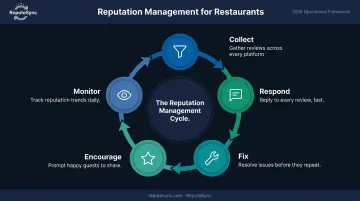
The Reputation Management Cycle
This is the loop that separates restaurants leading local search from those struggling to be found:
- Collect — Actively gather feedback through QR codes, follow-up messages, and review platforms
- Respond — Acknowledge every review publicly, positive and negative
- Fix — Turn recurring patterns into operational improvements
- Encourage — Satisfied guests are far more likely to leave a review when asked (83% of consumers will leave a review when prompted, per BrightLocal's 2024 Local Consumer Review Survey)
- Monitor — Track results, watch for new issues, repeat
Most restaurants run this loop manually — and inconsistently. Repute Sync automates the monitoring, collection, and performance tracking, so owners can focus on the floor rather than juggling review platforms. Book a demo at reputesync.com to see how it works for your location.
Frequently Asked Questions
What is customer feedback?
Customer feedback is any information guests share about their experience — written reviews, star ratings, post-visit surveys, verbal comments to staff, and social media posts covering everything from food quality to ambiance.
What are customer feedback examples for restaurants?
Examples range from a five-star Google review praising the pasta to a Yelp complaint about a 45-minute wait, a post-visit SMS survey rating food quality 3 out of 5, or a guest telling your server the soup arrived cold — each at a different level of detail and visibility.
What are the 3 C's of feedback?
The 3 C's are Clear, Concise, and Constructive. Vague complaints are hard to act on — feedback that hits all three marks, whether from a guest review or a team debrief, is what drives real improvement.
How should restaurants respond to negative customer feedback?
Respond within 24–48 hours, acknowledge the issue specifically, apologize without being defensive, and invite the guest to connect offline to resolve it. Keep your tone professional and empathetic — every potential diner will read how you handled it.
What is the best way for restaurants to collect customer feedback?
The most effective approach combines methods: QR code surveys at the table, post-visit SMS or email follow-ups, and consistent monitoring of review platforms — so you capture feedback from guests regardless of their preferred format.
How often should restaurants review customer feedback?
Feedback collection should be ongoing and automated where possible. Owners should review patterns at least weekly — looking for recurring themes across multiple reviews rather than reacting to individual comments in isolation.